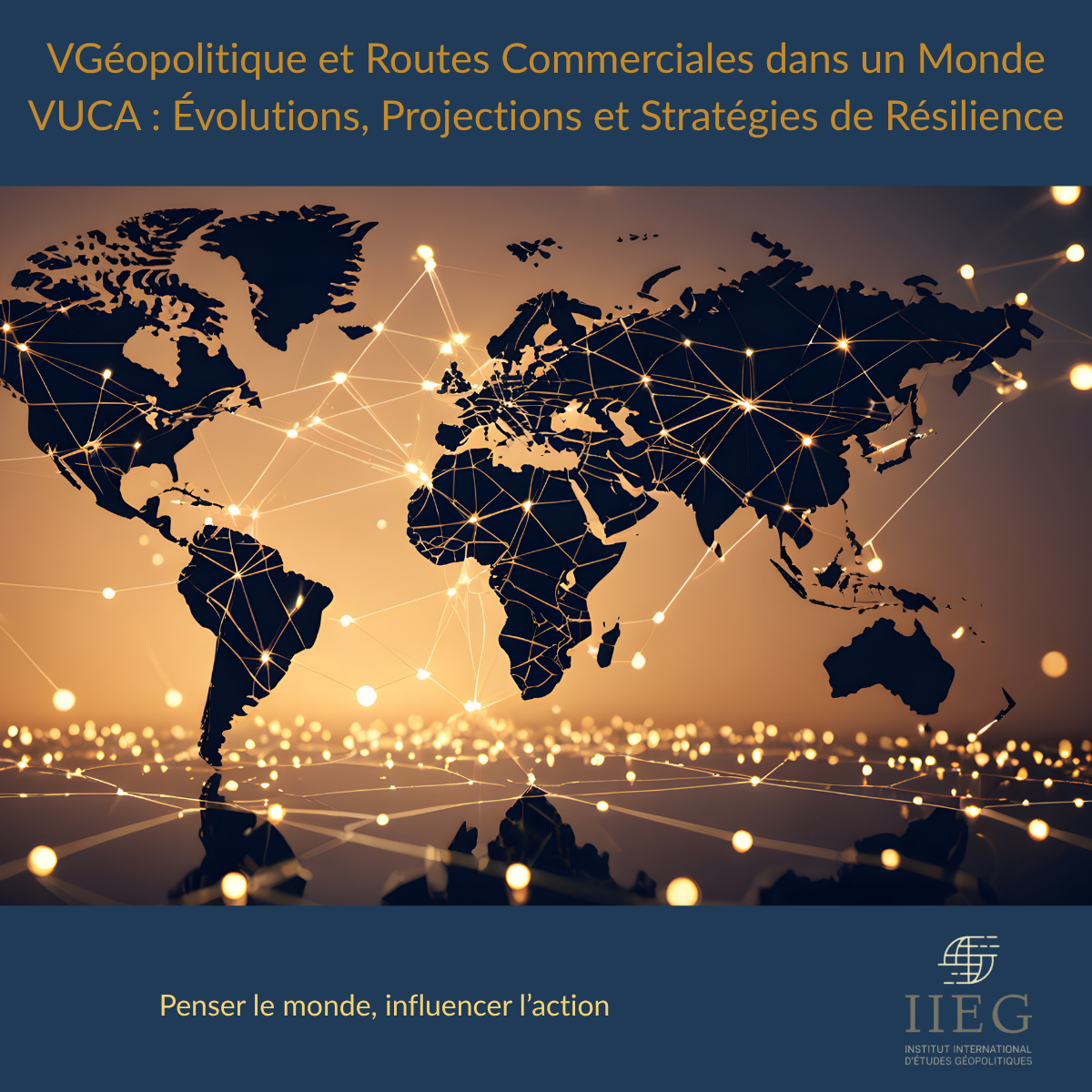
The COVID-19 episode has highlighted the flaws and weaknesses of too much specialization and globalization of the world, and has brought to the forefront concepts that we thought were outdated: regionalization, sovereignty, resilience, robustness of the supply chain, availability of inputs.
Geopolitical tensions, a consequence of the search for a new global balance itself the result of the evolution of the ideological, economic and demographic balance of power, have exacerbated this new reality for some, and reinforced the obvious for others.
In this study, we will deepen our reflection on trade routes and their intertwining in world geopolitics. This study is broken down into three parts: the first will deal with “hard” factors, in this case geography, demography, and will paint a brief picture of the history of trade routes; the second will focus on modern roads and the current situation; the third and final part will focus on the developments to be expected and on the appropriate way to position yourself in this new mapping of trade routes.
Part 1: The Hard and the History of Trade Routes
1.1 Geographic and Demographic Invariants
The world, from a geographical point of view, is divided into two interdependent universes: the earth for 29% and the ocean for 71%.
The northern hemisphere (255 million km²) concentrates the majority (66%) of the land surface, however its geographical center, in this case the north pole and its surroundings (Alaska and eastern Siberia) represent non-inhabitable zones and therefore a divide which separates America from Eurasia-Africa. The southern hemisphere has the remaining third (50 million km²) equivalent to 19% of its surface area, Antarctica (14 million km²) represents a significant uninhabitable part.
From this geographical observation, the earth's world is made up of two major blocks:
- The World Island America
- The continental world made up of Eurasia and its extension towards the south, sub-Saharan Africa
The demographic perspective teaches us that 90% of the world's population is located in the northern hemisphere along what we will call the
optimum living corridor, that is to say the corridor presenting the most favorable conditions for living things in terms of climate, access to water, and arable or pastoral land. This population is roughly distributed along a major axis from east to west between the Tropic of Cancer and the 60th parallel north.
1.2 Additional Factors at the National Level
Following these geographic and demographic invariants, it is useful at the national level to introduce two additional notions:
- The degree of openness of countries between landlocked states, states open to the seas, island states
- The degree of self-sufficiency of nations between countries rich in natural resources and producers, consuming countries and poor in resources, and crossroads countries with a commercial vocation
We will close this introduction to our problem with an important characteristic of an evolving nature over time: it is belonging to a specific and/or differentiated civilizational or cultural area which will tend to erase or accentuate the impact of geographical DNA.
1.3 Historical Fresco of Trade Routes
History teaches us that humanity began its growth on the basis of autonomous life nuclei and that trade and trade routes were almost non-existent. It was not until the birth in the third millennium BC of centers of civilizations in China, the Indus, Mesopotamia, and Egypt that the first exchanges and intra-civilizational routes appeared, relying mainly on waterways.
The Incense Route (around 1800 BC) appears to be the first known trade route and connects the Indian subcontinent and the Arabian Peninsula by sea. It developed thanks to camel caravans until it reached Mesopotamia and Egypt via the city of Petra in Jordan, which became an important commercial crossroads towards the eastern Mediterranean.
The Silk Road appears around 200 BC. BC, it opened the door to exchanges between the Chinese empire which held the secret of its manufacture and the Middle East via Samarkand. The Roman Empire around 30 BC. AD takes over the past, goes up the Nile, puts itself in contact with the kingdom of Aksum which masters navigation on the high seas, bypasses the Arabian peninsula and thus connects the Mediterranean basin to India. He doubles this route by land via the Parthian Empire and later the Sassanid Empire to reach Samarkand and China. Rome is replaced by Constantinople which becomes the new commercial crossroads between the West and the East.
The first globalization of the known world merges with the expansion of the Arab-Muslim world. At the Battle of Talas in 751 AD. BC, they defeated the Chinese, appropriated the secrets of silk and paper while the Chinese turned away from land routes to concentrate on maritime routes deemed safer and with fewer intermediaries, and opened their ports to foreigners. The Arabs seized the opportunity and established themselves at the center of the vast land and maritime trade network, uniting East to West and North to South. Africa was incorporated during the 10th century via trade in gold, slaves, and ivory. The era of the Crusades saw the Italian republics take charge of trade between the Middle East and Europe.
The first globalization of the world saw the light of day with the invention of the caravel, the rediscovery of the Americas by the Spaniards, and the opening of the route to India via the Cape of Good Hope by the Portuguese. The Ottoman Empire and its capital Constantinople lost their trade monopoly. The world is shared between the winners, the Tordesillas meridian and its equivalent in South-East Asia demarcate the respective zones of influence.
The rest merges with the imperial reconfigurations, England and France ensure the first succession, the USA takes over in the 20th century and guarantees the
pax americana on all trade routes. The GATT and then the WTO agreements completed the movement to achieve the current configuration.
Part 2: Where are we? State of World Trade
The current configuration of trade routes is the product of this thousand-year-old history, but it is today being put to the test by a succession of crises which reveal its structural fragilities and call into question the established balances.
2.1 The Vital Arteries of Today's Commerce
Maritime transport remains the backbone of global trade, confirming the natural predominance imposed by the Earth/Ocean divide identified in our geographic invariants. It accounts for nearly
90% of the volume of goods traded worldwide [1], a proportion that has continued to grow since the advent of containerization in the 1960s.
Flows are today concentrated on three main routes which connect the large basins of the “optimum corridor of life”:
The Asia-Europe route is the busiest axis in the world. It crosses the Strait of Malacca, the Indian Ocean, the Red Sea and the Suez Canal before reaching the Mediterranean. The Suez Canal, a strategic infrastructure 193 km long, sees approximately
12% of world trade and
22% of container traffic [2]. This route perfectly illustrates the vital connection between the “Eurasia-African continental world” and European markets.
The Trans-Pacific Highway connects China and East Asia to the west coast of North America, materializing trade between the “continental world” and “island world America”. This route has taken on considerable importance with China's economic rise and its integration into global value chains.
The Trans-Atlantic route, historically central since the great discoveries, continues to connect Europe and North America, although its relative importance has diminished with the rise of Asia.
2.2 “Choke Points”: Zones of Geopolitical Friction
These routes depend on strategic crossing points whose disruption can paralyze global trade, confirming the historical importance of controlling commercial crossroads. These “choke points” have become major geopolitical issues.
| Strangulation Point |
Crisis Context |
Impact on Trade |
| Suez Canal / Red Sea |
Houthi attacks since the end of 2023 following the Gaza-Israel conflict |
Fall of 60% in traffic in 2024. Loss of revenue of 62% for Egypt (3.6 billion USD). Diversion via the Cape of Good Hope (+10-15 days) [3] |
| Panama Canal |
Historic drought linked to climate change |
Drastic reduction in the number of daily transits, affecting a route that accounts for 3% of global maritime trade |
| Strait of Hormuz |
Recurring geopolitical tensions with Iran |
Vital crossing point for approximately 20% of global oil consumption |
| Strait of Malacca |
Piracy, high traffic density and Sino-American tensions |
Essential route for trade between Asia, Europe and the Middle East |
The most notable example of this vulnerability remains the blocking of the Suez Canal by the container ship
Ever Given in March 2021. This incident, which lasted six days, dramatically illustrated the fragility of the global trading system, with an estimated cost of
$5 to $9 billion per day for international trade [2]. More than 400 ships have been blocked, creating cascading disruptions in global supply chains.
2.3 New Logics and Emerging Roads
Faced with these tensions and vulnerabilities, new dynamics are developing, recalling the major historical reconfigurations of trade routes analyzed in Part 1.
The “New Silk Roads” (Belt and Road Initiative - BRI) represent the most ambitious Chinese attempt to recreate ancient land networks while developing alternative maritime routes. Launched in 2013 by President Xi Jinping, this infrastructure project has already mobilized more than $900 billion in investments in more than 150 countries [4]. In 2024, a record
$70.7 billion in construction contracts was signed. The initiative aims to secure Chinese supply chains, reduce dependence on traditional maritime routes controlled by Western powers, and expand Beijing's geopolitical influence.
The Northern (Arctic) Sea Route illustrates how climate change can literally reshape global trade geography. The melting of the Arctic ice is gradually opening a new sea route along the Siberian coast, potentially revolutionary for trade between Asia and Europe. Although traffic reached a record in 2024 with nearly
38 million tonnes, it is still 12 times lower than that of Suez [5]. This route, actively promoted by Russia and supported by China, could reduce the distance between Asia and Europe by 40%, but it raises important environmental and geopolitical questions, particularly in the context of Western sanctions against Russia.
The Regionalization of Trade marks a return to the logic of geographical proximity and cultural affinities, confirming the importance of the civilizational factor identified in our analysis. In reaction to hyper-globalization and its fragilities, intraregional trade is intensifying. They now represent more than
70% of trade flows in Europe and exceed
50% in Asia [6], creating value chains that are shorter, more resilient and less exposed to global geopolitical shocks.
Part 3: Where Are We Going and How to Ensure Resilience? Projections and Strategies
The future of trade routes is taking shape in an environment where geopolitical uncertainty has become the new normal. For businesses and governments, the challenge is no longer just to optimize costs and efficiency, but to build resilience capable of anticipating, absorbing and adapting to multiple shocks.
3.1 Structural Trends to Anticipate
An increase in crises and disruptions: In a context of scarcity of resources, energy transition, technological acceleration, increase in population and global demand, and decline of the dominant power guaranteeing balance, it is highly probable that global rebalancing will result in imbalances and increasingly violent crises.
Towards a Fragmented “Slowbalization”: We are witnessing a slowdown and fragmentation of globalization. Global trade growth is expected to stabilize at around
2% per year until 2028 [7], well below the growth rates of previous decades. This “slowbalization” is accompanied by a reorganization around geopolitical blocs and civilizational affinities, confirming the importance of the cultural factor identified in Part 1. Companies will have to navigate a system where customs, environmental and technical standards vary from one region to another.
Safety before Cost: The “just-in-time” paradigm, which has dominated global logistics for decades, is gradually giving way to a “just-in-case” logic. This transformation favors the diversification of supply sources, the creation of safety stocks and operational flexibility over pure cost optimization. Companies now agree to pay a “resilience premium” to secure their supply chains.
Technology Acceleration: Artificial intelligence, the Internet of Things (IoT) and blockchain offer powerful tools to improve the visibility, traceability and predictive management of supply chains. These technologies enable more proactive risk management and the ability to respond more quickly to disruptions.
3.2 Resilience Strategies for Businesses
To build increased resilience, businesses must adopt a multidimensional approach that combines geographic diversification, technological innovation and organizational agility.
Mapping and Diversifying the Supply Chain: It has become crucial for companies to no longer depend on a single supplier or a single geographic region. This diversification requires detailed knowledge of the entire chain, including tier 2 and 3 suppliers, to identify hidden points of vulnerability. Companies must use advanced software solutions to gain this complete visibility and develop alternative sourcing strategies.
The
“China + 1” approach perfectly illustrates this strategy. It consists not of leaving China, but of developing an alternative source of supply in a third country (Vietnam, India, Mexico, Turkey) to spread geopolitical and operational risks. This strategy helps maintain the advantages of China's industrial ecosystem while guarding against disruption.
Regionalize and Shorten (Nearshoring/Reshoring): The trend towards geographical proximity of production is accelerating. Companies are re-evaluating their total cost of ownership (TCO) by integrating hidden costs: geopolitical risks, transport times, storage costs, environmental impact and operational flexibility.
The example of
IKEA illustrates this transformation. The Swedish furniture giant has decided to move part of its production from Asia to
Türkiye to better serve the European market. This decision follows a six-fold increase in container freight costs from Asia during the pandemic (from $2,000 to $12,000) [8]. Turkey, through its strategic geographical position between Europe and the Middle East, offers an optimal compromise between production costs and proximity to end markets.
Investing in Technology for Visibility and Agility: Leading companies are investing heavily in technologies that allow them to anticipate and respond more quickly to disruptions.
The
blockchain is revolutionizing product traceability and the simplification of customs procedures. The example of
Walmart is particularly enlightening: the company uses blockchain to trace its food products, allowing it to trace the source of contamination in a few seconds instead of several days. This instant traceability capability significantly reduces costs associated with product recalls and improves consumer safety.
artificial intelligence enables predictive risk modeling and dynamic optimization of inventory and routes. Algorithms can analyze thousands of variables (weather conditions, geopolitical tensions, price movements) in real time to recommend proactive adjustments.
3.3 Recommendations for Global Trade Governance
The fluidity of trade does not only depend on business strategies. Public actors have a crucial role to play in creating a stable and predictable environment, recalling the historical importance of the “pax” (Roman, British, then American) to secure trade routes.
Strengthen Cooperation on “Choke Points”: Faced with the multiplication of crises affecting strategic crossing points, it is becoming urgent to promote international statutes guaranteeing the neutrality and security of these vital infrastructures. The “Guardian of Prosperity” operation launched by the United States in the Red Sea in 2024 illustrates this need, but it must evolve towards truly multilateral surveillance missions to be accepted by all players in world trade.
Harmonize and Digitalize Procedures: Accelerating the adoption of common data standards and digital documents (electronic bill of lading, e-CMR, digital certificates of origin) would make it possible to considerably streamline border crossings, reduce administrative costs and improve the traceability of goods. This digitalization is all the more urgent as customs controls become more complex with the multiplication of environmental and security regulations.
Investing in Alternative and Redundant Infrastructure: To reduce dependence on traditional maritime routes and vulnerable “choke points”, it is essential to support the development of multimodal corridors (rail-road-sea) which offer credible alternatives.
The
“Middle Corridor” (passing through Central Asia, the Caspian Sea and the Caucasus) and the
“India-Middle East-Europe Economic Corridor (IMEC)” announced during the 2023 G20 represent strategic opportunities to diversify flows and bypass areas of instability. These projects, although less publicized than the Chinese New Silk Roads, could offer more geopolitically neutral alternatives.
Towards a New Geopolitics of Flows
This analysis confirms that the geographic and demographic invariants identified in Part 1 continue to fundamentally structure global trade, but their expression is evolving profoundly under the effect of geopolitical tensions, technological innovations and environmental imperatives.
The golden age of fluid and optimized globalization, guaranteed by the Pax Americana and framed by stable multilateral institutions, seems definitively over. We are entering an era of geopolitical competition where the control of flows once again becomes a central attribute of power, recalling the millennia-old lessons of the history of trade routes.
This transformation does not mean the end of globalization, but rather its evolution towards a more fragmented, more regionalized and more resilient system. The trade routes of tomorrow will probably be more diversified, more technological and more environmentally friendly, but also more politicized and more instrumentalized.
For businesses, resilience is no longer an option but a condition for survival in this new environment. Those who succeed will be those who are able to transform this new situation into a competitive advantage, by building supply chains that are not only efficient and optimized, but above all diversified, agile, intelligent and sustainable.
History teaches us that each major geopolitical reconfiguration has redrawn the map of trade routes. Today we are probably experiencing one of these major reconfigurations, the definitive contours of which will only emerge over the coming decades. The players who know how to anticipate and adapt to this transformation will be the winners in the next era of global trade.
In this
VUCA universe, the key to resilience will lie in the
capacity to adapt. Trade routes will continue to be the arteries of the world, but their trajectory will now depend less on geography and more on strategy. Power, tomorrow, will belong not to the one who controls the sea, but to the one who knows how to anticipate the storms.
References
[1] National Maritime Museum, “Infographics: the key figures of maritime trade”, 2023.
[2] UNCTAD, “Maritime Transport Study 2024 - Strategic maritime crossing points: navigating the pitfalls”, 2024.
[3] Directorate General of the Treasury, “Suez Canal traffic: from one crisis to another”, August 26, 2025.
[4] Green Finance & Development Center, “China Belt and Road Initiative (BRI) Investment Report 2024”, February 27, 2025.
[5] Mer et Marine, “Russia: traffic on the northern sea route increased in 2024”, January 8, 2025.
[6] World Trade Organization, “World Trade Report 2024”, 2024.
[7] UNCTAD, “World Maritime Trade Outlook 2025”, September 2025.
[8] Reuters, “IKEA to shift more production to Turkey to shorten supply chain”, October 6, 2021.