Diplomacy & South-South Cooperation
14 October 2025
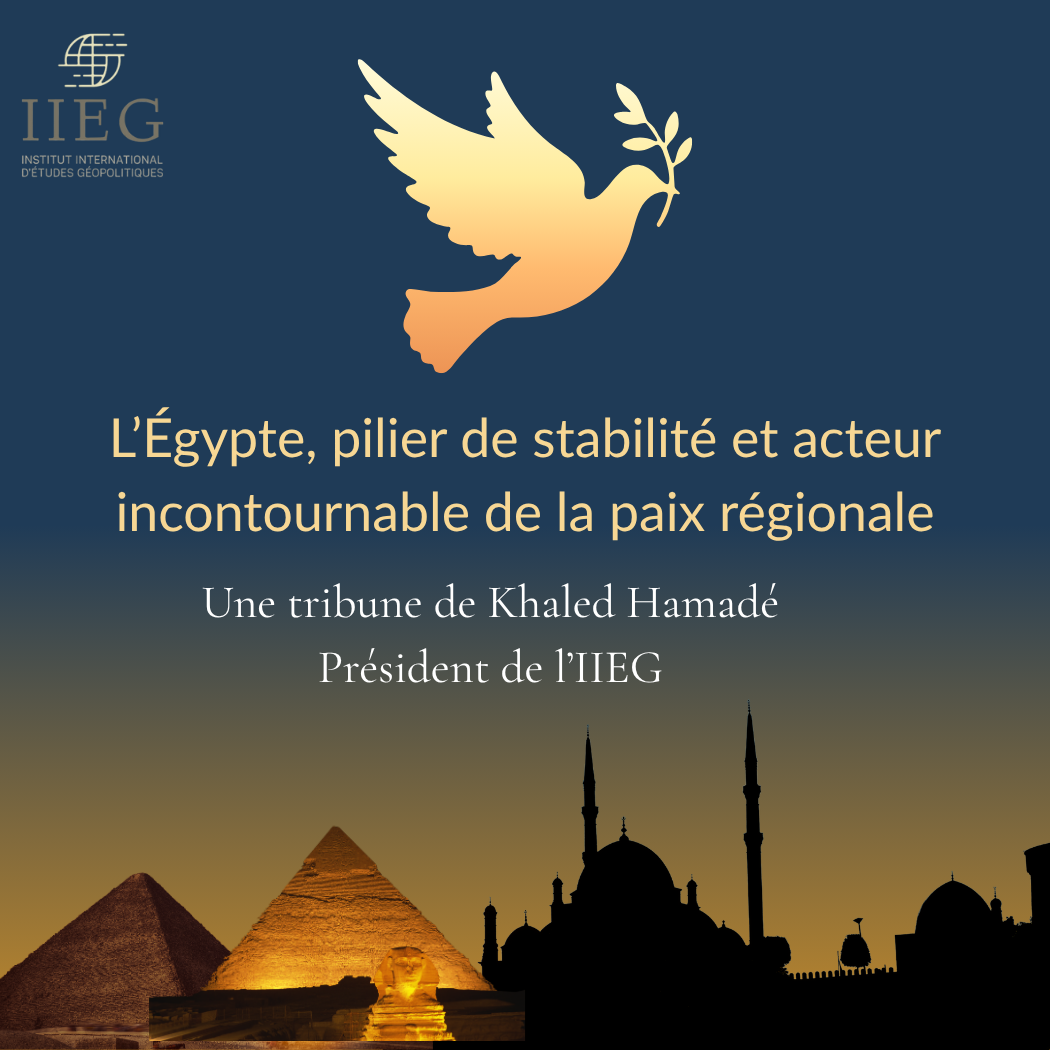
Egypt, pillar of stability and key player in regional peace
K
Khaled Hamadé
IIEG Expert
A quiet force at the heart of regional turbulence
In a Middle East plagued by violent changes and increasingly acute rivalries, Egypt remains one of the rare states to have been able to preserve a line of conduct based on reason, moderation and the search for consensus. For decades, Cairo has established itself as a quiet force: a balancing power, heir to a long diplomatic tradition shaped by Pharaonic history, the wisdom of Arab-Muslim civilization and the spirit of national responsibility.
A diplomacy of moderation and responsibility
In a period where regional balances are under strain and where voices of confrontation attempt to stifle those of dialogue, Egypt reaffirms its central role in favor of peace, stability and the sovereignty of nations. Under the leadership of President Abdel Fattah al-Sissi, Egypt has maintained a clear and consistent position of principle: that of respect for international law, the rejection of violence in all its forms and the defense of human dignity. This posture, deeply rooted in the history and values of the Egyptian people, reflects the conviction that peace is not an option, but a shared responsibility.
Cairo, nerve center of regional diplomacy
Despite the considerable challenges and human tragedies unfolding on its borders, Egypt has chosen the path of reason and restraint. It tirelessly continues its diplomatic efforts, mobilizing its mediation channels to promote a comprehensive and lasting ceasefire, and create the conditions for an inclusive dialogue between all parties concerned. In recent months, Cairo has once again become a nerve center of regional diplomacy, welcoming heads of state, politicians and international representatives determined to find a way out of a crisis of unprecedented magnitude. Through its constant action, Egypt has demonstrated that the search for peace is a long-term commitment, based on trust, mutual respect and the vision of a common future. Today, while tensions persist and extremism seeks to sabotage any progress, Egypt remains faithful to its historic vocation: working for reconciliation, defending the legitimacy of dialogue and preserving regional stability. Its commitment to peace is not a matter of calculation, but of a duty towards the people and generations to come. History will remember that, in this critical phase, Egypt played its role with courage, wisdom and constancy. She was able to make the voice of moderation heard in a world in search of balance, which by definition remains very fragile.
A strategic vision integrating development and security
Far from being limited to a diplomatic posture, the quest for peace in Egypt is part of a global strategic vision. Cairo understands that political security cannot be dissociated from economic development, social justice and regional cooperation. This is why Egypt invests in cross-border projects – whether energy, water, trade or infrastructure – in order to consolidate an area of shared prosperity. In this logic, peace becomes a civilization project. It is nourished by education, interreligious dialogue, the fight against extremism and the promotion of a culture of coexistence.
Presentation of the author
The article by Khaled Hamadé, President of the International Institute of Geopolitical Studies, is a geopolitical analysis which highlights the crucial and moderating role of Egypt in a Middle East marked by strong tensions. The author highlights Egyptian diplomacy, under the leadership of President Abdel Fattah al-Sisi, as a constant and committed force in favor of dialogue, respect for international law and stability. The article presents Cairo as a nerve center of the negotiations, working tirelessly for de-escalation and the search for lasting peaceful solutions. This commitment to peace is carried by a particularly legitimate voice, that of Khaled Hamadé. As president of the International Institute of Geopolitical Studies, his expertise is recognized. But even more, his plea for peace is deeply rooted in his personal experience. Having himself suffered, along with the Lebanese people, the atrocities and suffering of the Lebanese war, he devoted his life to working on the path of reconciliation and dialogue. His career makes him a convinced man of peace, whose writings are not simple analyses, but powerful testimonies on the need to prefer diplomacy to confrontation.