
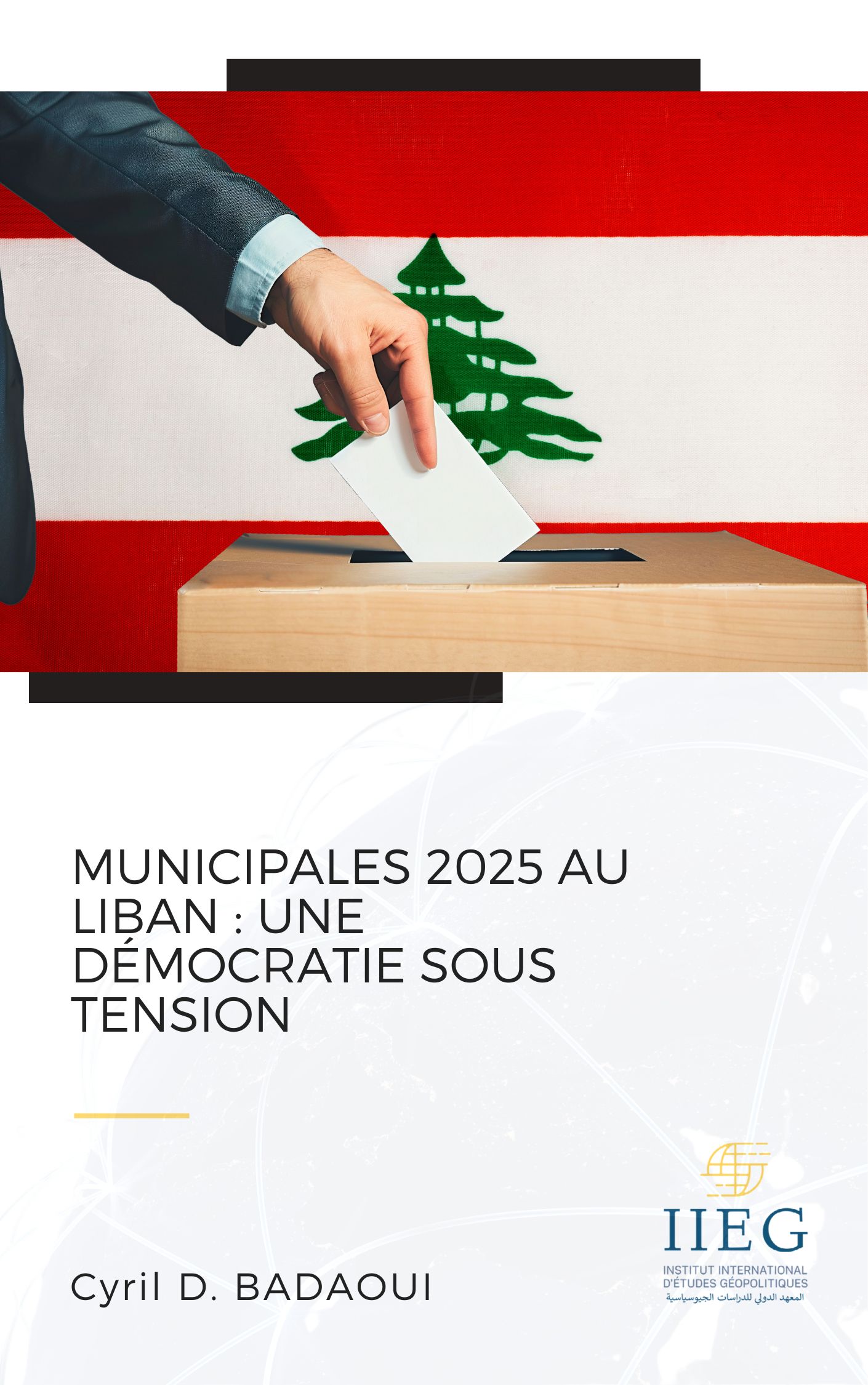
Municipal elections 2025 in Lebanon: A democracy under tension!
Cyril D. BADAOUI
IIEG Expert
Since 2019, Lebanon has been going through a multidimensional crisis profoundly affecting its democratic institutions. The municipal elections, initially scheduled for 2022, have been postponed several times due to major factors such as the COVID-19 pandemic, the economic collapse, as well as the deterioration of security in the south of the country, marked by recurring clashes between Hezbollah and Israel.
This postponement has raised serious concerns about the continuity of the democratic process and the legitimacy of local authorities, especially since municipal councils ensure the management of essential public services. Many councils have also resigned or ceased to function since the last elections in 2016, due to lack of financial resources or personnel.
Lebanese President Joseph Aoun nevertheless reaffirmed his commitment to the return to stable democratic life, a commitment shared by the government. This commitment was materialized in the preparations and holding of the 2025 municipal elections.
1. Issues in the 2025 municipal elections
a. Local governance and public services
Lebanese municipalities play a key role in providing services such as waste management, infrastructure maintenance and social services. Their dysfunction accentuates regional inequalities, particularly in rural areas, and weakens national cohesion.
b. Preparation for the 2026 legislative elections
Municipal elections often serve as a life-size test for political parties, with a view to legislative elections. They allow them to evaluate their local presence, test alliances and adjust their strategies. Their postponement disrupted this preparatory process.
c. Youth mobilization
Increased participation of young people, particularly through candidacies, reflects a desire for political renewal. This dynamic could significantly influence future elections, in particular the legislative elections of 2026.
The final results will allow an initial analysis of the young profiles who won this election.
2. The role of regional forces
a. The influence of Hezbollah
Hezbollah, supported by Iran, remains a major political and military player, especially within the Shiite community. However, it was weakened by the deadly conflict of September/October 2024, marked by the assassination of its leading figures, including Hassan Nasrallah and his successor Hashem Safieddine.
This military and political setback, amplified by the loss of key regional allies such as the Syrian regime of Bashar El-Assad, has led to growing international pressure for its disarmament. Despite this, the municipal elections represent a crucial opportunity for Hezbollah to demonstrate its resilience and maintain its link with its popular base.
b. Security fragmentation
The absence of strong state governance has favored the emergence of local militias, including Hezbollah, often supported by foreign powers. This fragmentation considerably complicates the political stabilization of Lebanon.
c. New geopolitical order in the Middle East
Lebanon is directly impacted by regional geopolitical transformations: readjustments of alliances, diversification of partnerships, rise of new technological centers.
These changes offer a window of opportunity to parties opposed to Iranian influence, who seek to break with the status quo and propose a sovereign and modern political alternative.
3. Prospects for the 2026 legislative elections
The 2026 legislative elections will be a decisive moment to reshape the Lebanese political landscape. New forces could emerge, alliances reformed. But the success of this election will depend on the ability to guarantee a free, secure and fair electoral environment, in a context still marked by economic and security instability.
Conclusion
Lebanon is at a turning point. The 2025 municipal elections constitute a crucial test of the government's ability to reconcile security stability and democratic demands.
Their results will provide a valuable reading of the state of public opinion and will serve as a strategic basis for the parties with a view to the 2026 legislative elections.
In this tense context, the persistent presence of Hezbollah, calls for its disarmament, and international geopolitical pressures further complicate the situation.
Finally, the The role of the Lebanese army and security forces remains central: they not only ensure the holding of the vote, but also the defense of a democratic process in the service of citizens.
References:
-
Here Beirut
-
L’Orient-Le Jour
-
The World
-
Libnanews – Lebanese Citizen Media