Loading...
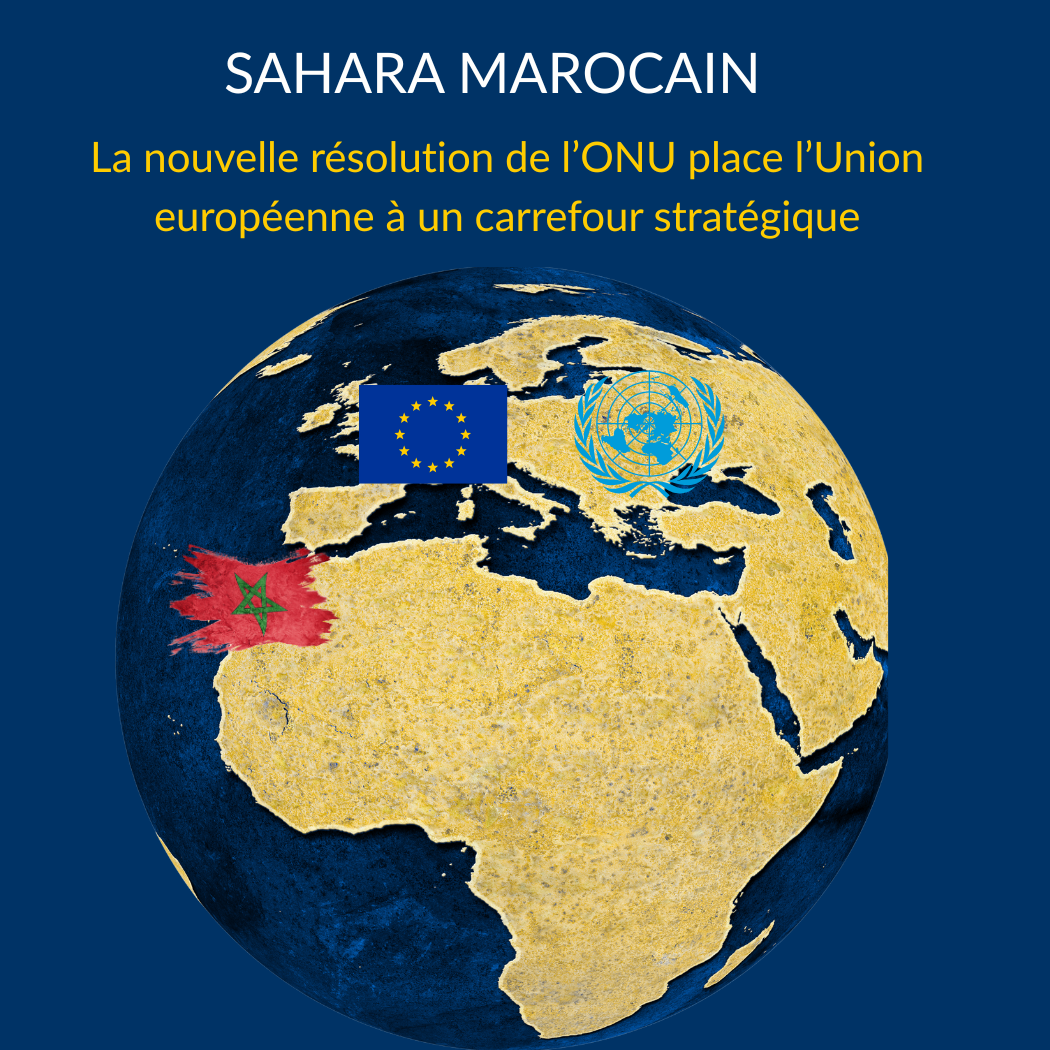
Moroccan Sahara: the new UN resolution places the European Union at a strategic crossroads
Geopolitics & Strategy 04 November 2025

Moroccan Sahara: the new UN resolution places the European Union at a strategic crossroads

P

Pôle Analyse et Résolution des Conflits de l\'IIEG

IIEG Expert

The adoption, on October 30, 2025, of resolution S/2025/692 by the United Nations Security Council marks a historic inflection in the governance of the Moroccan Sahara issue.

By explicitly consecrating the Moroccan Autonomy Initiative (presented in 2007) as the only serious and credible basis to achieve a negotiated political solution, the international community has chosen political realism and lasting peace. This development places the European Union (EU) before a major strategic responsibility: aligning itself with UN legitimacy and the international dynamic driven by the United States, the Gulf countries, and the majority of the African continent. Refusing this alignment would amount to maintaining an ambiguity incompatible with the principles of coherence and global partnership that the EU claims in its external action.

A historical and legal turning point in the processing of the file

resolution S/2025/692 is not limited to extending the mandate of MINURSO. It introduces a real rereading of the political process, in a triple movement of clarification, refocusing and accountability.

The legal consecration of the Moroccan Autonomy Initiative

Since its presentation in April 2007, the Moroccan autonomy plan has gradually gained international recognition. Described on numerous occasions by the Security Council as “serious and credible” (Res. 1754, 1783, 1813, 1979, 2099, 2468, 2602, 2654), it is now established as an exclusive reference in resolution S/2025/692. This development marks the definitive marginalization of the referendum option, deemed unrealistic by the UN since the report by James Baker II (2004)[1]. “The self-determination referendum, in current conditions, has become a diplomatic fiction. Autonomy under Moroccan sovereignty is the only viable framework for stability.” — Extract from the report of the Secretary-General to the Security Council, 2025[2]. The text of the resolution is therefore part of a rational continuity: it consolidates the approach of “realistic, pragmatic and sustainable political solution” as expressed in the resolutions after 2018, but crosses a threshold by elevating autonomy to the rank of exclusive solution.

Explicit recognition of Algeria’s role

Another major innovation: the Security Council now designates Algeria as a stakeholder in the process. This recognition breaks with the diplomatic rhetoric which presented it as a simple “neighboring state”. It endorses a geopolitical reading of the conflict based on direct regional responsibility and not on a colonial abstraction. This development puts an end to a diplomatic asymmetry long exploited to delay the political process.

The doctrine of political realism

Resolution S/2025/692 reaffirms that the solution must be “mutually acceptable”, but specifies that autonomy “constitutes the most realistic and achievable path”. This formulation, supported by the United States, France and the United Arab Emirates, reflects the consolidation of an international consensus around realism, going against the ideological postures of the 20th century.

The Moroccan Sahara: from diplomacy to territorial governance

Beyond the UN framework, the credibility of the Moroccan position is based on an irrefutable reality on the ground: that of a peaceful, structured territory, and fully integrated into the national development model.

The southern provinces: a model of stability and development

The New Development Model of the Southern Provinces, launched by His Majesty King Mohammed VI in 2015, mobilized more than 80 billion dirhams around structuring axes:
  • Atlantic port of Dakhla, future hub between Africa and Europe;
  • Wind and solar parks in Laâyoune, Boujdour and Aftissat;
  • Seawater desalination plants and sustainable irrigation projects;
  • Roads and air links integrating the region into the national logistics network.
These investments demonstrate a strategic vision: making the Sahara a growth pole and an Afro-Atlantic link. The UN, the World Bank and the ADB now recognize this trajectory as a success of integrated territorial development[3].

A social and institutional dynamic

Autonomy, as proposed by Morocco, is based on the principles of the 2011 Constitution: local democracy, citizen participation and parity. The regional councils of Laâyoune-Sakia El Hamra and Dakhla-Oued Eddahab illustrate this inclusive governance, combining Sahrawi identity and institutional responsibility.

The Euro-African dimension: the European Union facing a strategic choice

The European Union, Morocco's major economic and political partner, now finds itself at a crossroads. The cautious neutrality which until now characterized its position is becoming difficult to maintain in view of international realities.

Political coherence and international legitimacy

Ignoring the new UN legal architecture would amount to weakening its own credibility for the EU. The decision of the Court of Justice of the European Union (CJEU) in 2023, temporarily suspending the EU-Morocco agricultural and fisheries agreements, found itself overtaken by recent diplomatic developments and by the increased recognition of the stabilizing role of the Kingdom in the region[4]. A political revision is therefore necessary: ​​align European foreign policy with resolution 2025/692, in the name of strategic coherence and respect for multilateralism.

A partnership for stability and security

Morocco today constitutes the main security pivot on the southern flank of Europe: counter-terrorism cooperation, fight against irregular migration, maritime control and clean energy. A European clarification would strengthen Euro-African collective security, by consolidating the basis of political trust necessary for lasting cooperation.

An economic and energy opportunity

Sahara autonomy would create the conditions for shared economic growth. The region's integration into the Nigeria-Morocco Gas Pipeline, the African Atlantic Road and the green hydrogen corridors positions the Kingdom as an energy and logistics interface between the two continents. European companies could find a green investment lever, in line with the European Green Deal and the global energy transition[5].

IIEG analysis: towards a geopolitics of courage

In his column “For lasting peace: 50th anniversary of the Green March”, the president of the IIEG, Khaled Hamadé, wrote: "Courage is not to perpetuate conflicts, but to dare to resolve them. Morocco showed the way fifty years ago. It is time for the world to accompany it on this path."[6] This statement summarizes the doctrine of the IIEG: peace is not a status quo, it is a strategic choice. The time has come for regional and international actors — first and foremost the European Union — to move from observation to commitment, from discourse to decision.

A historic opportunity for Europe and for peace

Resolution S/2025/692 marks the move beyond the postcolonial paradigm in favor of a geopolitics of responsibility. By aligning with this dynamic, the European Union would have the opportunity to strengthen its presence in a strategic region, while consolidating an exemplary partnership with Morocco. Ultimately, it is no longer just an African issue, but a major Euro-Atlantic issue: that of the stability of the southern flank, energy security and cohesion between the two banks. Morocco, through its constancy, legitimacy and vision, offers the international community an honorable and lasting exit from a dispute inherited from the 20th century. The IIEG will continue to monitor this development and contribute, through its work, to the development of a diplomacy of realism and peace, faithful to the spirit of the Green March and the universal vocation of Morocco.   Notes and references [1] Report of James Baker II to the Security Council, United Nations, 2004. [2] Report of the Secretary-General on the situation concerning Western Sahara, UN document S/2025/588. [3] African Development Bank (AfDB), “Morocco and the new Atlantic economy”, Report 2024. [4] CJEU, Case T-344/19 and T-356/19, judgment of September 29, 2023. [5] Moroccan Ministry of Energy Transition, “National roadmap for green hydrogen”, Rabat, 2024. [6] Khaled Hamadé, “For lasting peace: 50th anniversary of the Green March”, International Institute of Geopolitical Studies (IIEG), October 2025. For lasting peace: 50th anniversary of the Green March and appeal to the international community