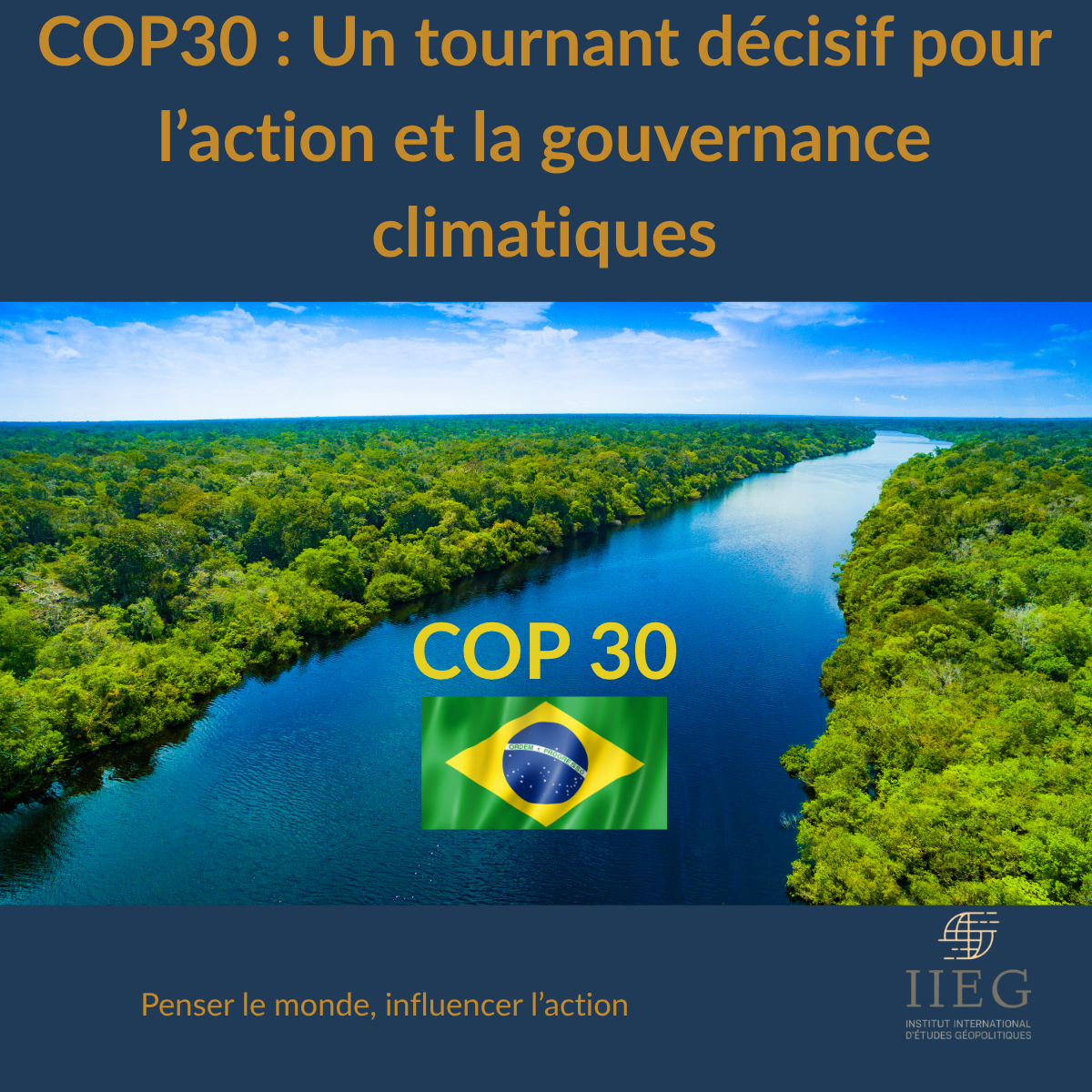
The 30th Conference of the Parties (COP30) to the United Nations Framework Convention on Climate Change (UNFCCC), which will be held from November 10 to 21, 2025 in Belém, Brazil, represents much more than just a deadline on the international diplomatic agenda.
With its symbolic location at the gates of the Amazon, the vital lung of the planet and a major reservoir of biodiversity, this conference is a pressing call for renewed, ambitious and equitable climate action.
In a context of multiple geopolitical crises, erosion of multilateralism and rising climate perils, COP30 constitutes a truth test for the credibility of the Paris Agreement and the capacity of the international community to transform its commitments into concrete actions.
The Sustainable Development Nexus division of the IIEG provides here its analysis of the issues and formulates proposals to make this summit a tangible success, by placing the preservation of forests at the heart of the solution.
Crisis-proof climate multilateralism
COP30 opens in a climate of mistrust. Geopolitical tensions, exacerbated by conflicts and aggressive economic competition, have relegated the climate emergency to the background of political priorities [1].
The architecture of climate governance, designed for cooperation, has become an arena of rivalry, undermining trust and slowing the implementation of commitments.
This erosion of multilateralism manifests itself at several levels crucial to the success of the conference.
Ambition at a standstill:
The challenge of Nationally Determined Contributions (NDC)
The main issue at COP30 is the submission of the third generation of Nationally Determined Contributions (NDC 3.0), which must define countries' emissions reduction efforts by 2035.
These action plans are the heart of the mechanism for gradually increasing the ambition of the Paris Agreement.
However, the observation is alarming: as the deadline approaches, a majority of countries, including some of the largest emitters in the G20, have not submitted contributions aligned with a 1.5°C trajectory [2].
The UNFCCC synthesis report indicates that current commitments, even if fully implemented, would lead us towards catastrophic warming of almost 3°C by 2100 [1].
This lack of ambition is not only a technical failure; it is the symptom of a deep political crisis where short-term national interests and internal political polarization take precedence over collective responsibility.
The financing wall
The second shaky pillar is that of climate finance. COP30 must see the adoption of a New Quantified Collective Objective (NCQG) to replace the objective of 100 billion dollars per year, which has never been fully achieved or sufficient.
The needs are immense, estimated at several trillion dollars per year.
Negotiations stumble over the amount, the sources (public, private), the distribution between mitigation and adaptation, and the conditions of access for developing countries.
Without an ambitious and credible agreement on the NCQG, the countries of the South will have neither the means nor the confidence necessary to accelerate their transition, further widening the North-South divide.
Issue of COP30
State of play (November 2025)
NDC3.0
Third cycle of national climate commitments (horizon 2035).
Majority of countries lagging behind; overall ambition very insufficient for the 1.5°C objective.
Financing (NCQG)
New post-2025 climate financing objective.
Difficult negotiations on the amount (objective of $1,300 billion/year mentioned) and the terms.
Global Assessment
The first assessment (GST) concluded that there was a major deficit in action and ambition.
NDC 3.0 must integrate the conclusions of the GST, in particular the exit from fossil fuels.
Adaptation & Losses Operationalization of the framework for the Global Adaptation Goal and financing of the fund for Losses and Damages.
Lack of dedicated funding and clear metrics for adaptation.
The forestry imperative:
From the crisis to concrete proposals
Faced with this climate governance in crisis, the theme of forests, highlighted by the Brazilian presidency, offers a unique opportunity to realign discourses and actions.
Forests are not just a component of the climate solution; they are a sine qua non condition. They absorb nearly 16 billion tonnes of CO2 per year and shelter 80% of terrestrial biodiversity [3].
Yet the global forest crisis is worsening.
In 2024, the world lost 8.1 million hectares of forest, a figure that is increasing and 63% higher than the trajectory required to achieve the goal of zero deforestation in 2030 [4].
Harmful subsidies to agriculture and other destructive industries exceed green funding for forest protection by more than 200 times [4].
This hemorrhage, if not stopped, will render all other decarbonization efforts in vain.
The flagship initiative of COP30, the “Tropical Forests Forever Facility” (TFFF), launched by Brazil, aims precisely to reverse this destructive economic logic.
By seeking to mobilize $125 billion to compensate countries for protecting their forests, this fund represents a paradigm shift [5].
Based on this observation, the Sustainable Development Nexus division of the IIEG is putting forward four concrete proposals to make COP30 a turning point for forests and the climate:
-
Consolidate and universalize the “Tropical Forests Forever Facility” (TFFF) The TFFF is a major step forward, but its success depends on a rapid and massive financial commitment.
Proposal:
We call on G20 countries, particularly those that have not yet contributed, to commit at least 50% of the target of $25 billion in seed funds before the end of COP30.
It is imperative to establish transparent governance for the fund, co-led by donor countries and forest countries, with strong representation of civil society and indigenous peoples to ensure equitable and efficient allocation of resources.
-
Integrate binding and verifiable forest objectives into NDC 3.0
Forests are often the poor relation of national contributions.
Proposal:
The IIEG proposes the development, under the aegis of the UNFCCC, of a standardized and mandatory module for NDC 3.0, dedicated to the protection and restoration of forests.
This module should include quantified objectives (e.g.: X% reduction in gross deforestation by 2035), monitoring indicators based on harmonized satellite data, and an associated financing plan, directly linking forest objectives to national climate strategies.
-
Safeguard the role and rights of indigenous and local communities
Indigenous and local communities are the most effective stewards of forests, protecting 80% of the world's biodiversity on just 25% of the land [6].
The TFFF plans to allocate 20% of the funds to them, which is a first step.
Proposal:
We recommend the creation of direct funding mechanisms that bypass national administrative burdens to channel funds to communities.
At the same time, COP30 must catalyze a global movement for the legal security of their lands and territories, a sine qua non condition for their protection action.
The objective should be to double the share of climate finance that reaches them directly by 2030.
-
In-depth reform of forest carbon markets (Article 6 and REDD+)
Forest carbon credit mechanisms, such as REDD+, have been undermined by greenwashing scandals and a lack of environmental integrity [7].
Article 6 of the Paris Agreement offers a chance to start on a healthy footing.
Proposal:
The IIEG calls for the adoption at COP30 of strict rules for forest carbon credits under
Article 6, guaranteeing:
Additionality and permanence of emissions reductions; the absence of double counting; conservative and scientifically validated deforestation baselines; and fair and equitable revenue sharing with governments and local communities.
Any credit that does not meet these criteria must be excluded from compliance markets.
From research to action:
The expertise of the IIEG embodied by Yann FORTUNATO CEO of Racines de France.
Beyond analysis and policy recommendations, the IIEG Nexus cluster is committed to promoting and drawing inspiration from concrete solutions emanating from the field.
The action of researchers affiliated with our institute illustrates this transition from theory to practice.
A convincing example is that of Yann Fortunato, forestry consultant and director of Racines de France, a mission-driven company which embodies the new forestry economy that we are calling for [8].
Based on the principle that “a living tree must have more value than a cut tree”, Yann Fortunato and his teams develop silvicultural and agroforestry models that regenerate ecosystems while creating sustainable economic value.
This holistic approach is implemented through demonstrators, real open-air laboratories monitored by the scientific world.
The “Les Arches Castriotes” project, located in France in Castries near Montpellier (34), is a perfect illustration of this.
On a former 5-hectare vineyard site, more than 2,000 trees of 36 different species were planted to create a resilient agroforestry ecosystem, capturing carbon, restoring biodiversity, soil health and the water cycle [9]. The initiative carries a vision of a regenerative economy of territories for the benefit of resolving the need for nutritional autonomy and overall health.
This initiative, which is part of an ecosystem of actors including scientific partners and leading organizations, demonstrates through proof that innovative forestry and agroforestry management is not only possible, but also desirable.
Since agriculture is responsible for 80% of global deforestation, it is appropriate to propose protective models for residual global forests but also inspiring proposals to renew strong links between the presence of trees in territories and agriculture. The deployment of agroforestry, including Les Arches Castriotes through Yann FORTUNATO, is an inspiring example in the world.
It constitutes an inspiring model, reproducible on a larger scale, which can guide the investments and public policies that COP30 must catalyze.
Outlook
COP30 in Belém cannot afford to be a new step in the “geopolitics of climate procrastination”.
The ecological emergency, coupled with the crisis of global governance, demands a break.
By focusing on tangible, funded actions for forests, the international community can not only tackle a massive source of emissions and biodiversity loss, but also rebuild trust in the multilateral process.
The success of Belém will not be measured by the length of its final declarations, but by the solidity of the financial commitments for the TFFF, the ambition of the forest objectives in the NDCs, and the effective recognition of the role of forest guardians.
It is by this yardstick that history will judge whether COP30 was yet another mirage in the desert of inaction, or the beginning of a true ecological bifurcation.
References
[1] Montaigne Institute. (2025). COP30: multilateralism on the tightrope.
https://www.institutmontaigne.org/expressions/cop30-le-multilateralisme-sur-la-corde-raide
[2] CITEPA. (2025). Our guide to negotiations to better understand COP-30.
https://www.citepa.org/guide-du-citepa-des-entreprises-de-la-cop-30-lessentiel-pour-comprendre-le-contexte-des-negociations/
[3] Woodwell Climate Research Center. (2024). Global forest carbon storage, explained.
https://www.woodwellclimate.org/global-forest-carbon-storage-explained/
[4] Forest Declaration Assessment. (2025). Forest Declaration Assessment 2025.
https://forestdeclaration.org/resources/forest-declaration-assessment-2025/
[5] UN News. (2025). New Brazil-led fund aims to put forest protection at the heart of climate action.
https://news.un.org/en/story/2025/11/1166290
[6] The Guardian. (2025). How could Tropical Forest Forever fund proposed at Cop30 tackle deforestation?
https://www.theguardian.com/environment/2025/nov/06/tropical-forest-forever-fund-proposed-cop30-tackle-climate-change
[7] WeDemain. (2025). COP30: can Brazil save forests without greenwashing.
https://www.wedemain.fr/sauver-la-planete/actions-ecologique/cop30-le-bresil-peut-il-sauver-les-forets-sans-greenwashing-1142537
[8] Roots of France. (2025). Welcome.
https://www.racinesdefrance.com/
[9] Roots of France. (2025). The Castriote Arches.
https://www.racinesdefrance.com/project/les-arches-castriotes/