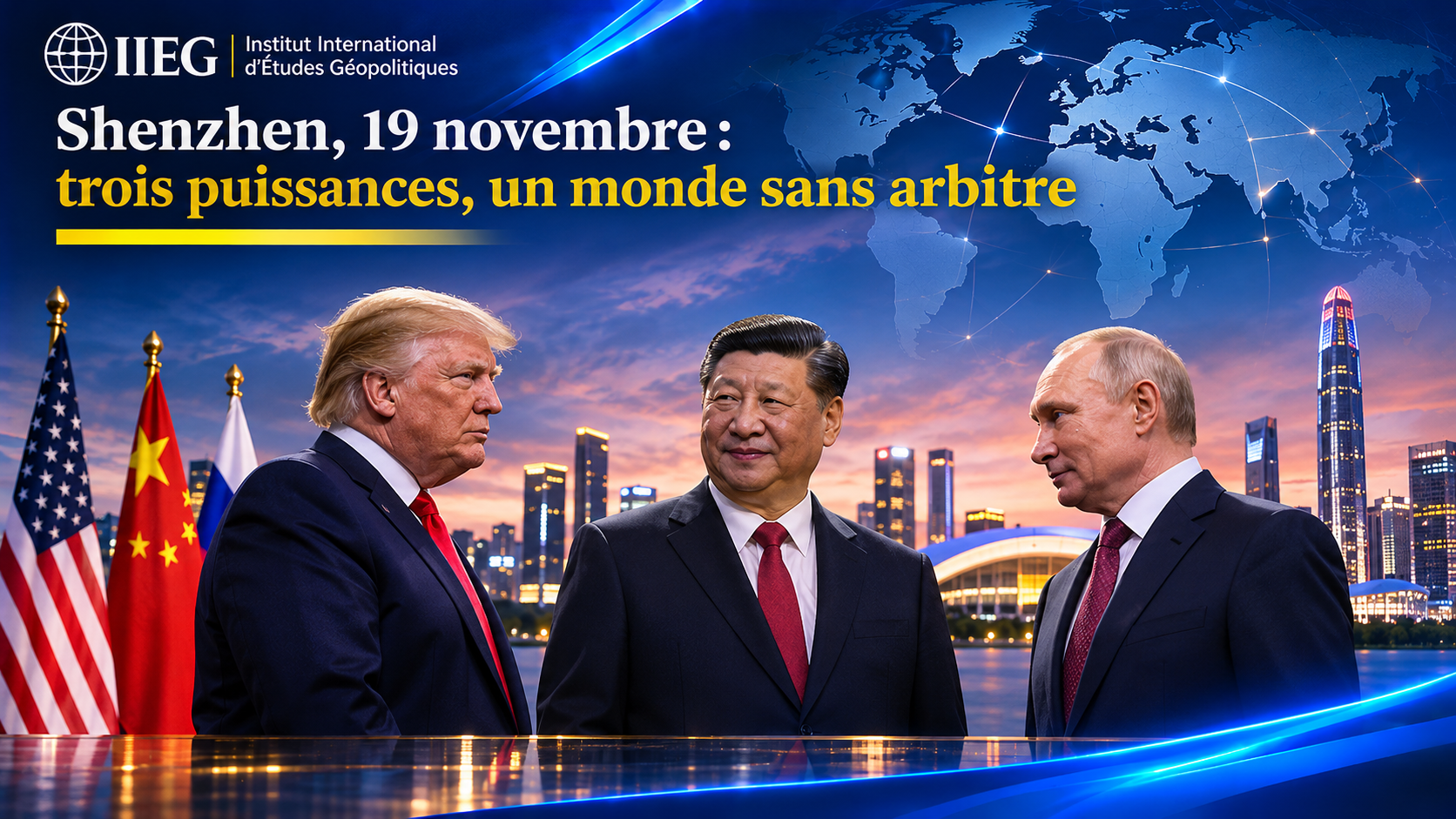
Shenzhen, November 19: Three Powers, a World Without an Arbiter

1. Shenzhen: Great Powers Return to the Center of International Affairs
On November 18, 2026, Donald Trump arrived in Shenzhen and was personally welcomed by Chinese President Xi Jinping. Vladimir Putin also arrived in China, where he was received by Cai Qi, one of the senior leaders of the Chinese Communist Party.
The November 19 trilateral summit, now confirmed by Washington, Beijing and Moscow, is a major diplomatic event. In this format, the leaders of the United States, China and Russia are coming together to discuss some of the most sensitive issues in international security.
The significance of the meeting lies not only in its agenda but above all in its format: three powers with decisive influence over global military balances are choosing direct dialogue amid the war in Ukraine, the conflict involving Iran, weakened arms control and commercial and technological tensions.
The international system established in 1945 has not disappeared. Multilateral institutions retain their legal existence and international legitimacy. Yet their ability to constrain great powers remains limited when those powers perceive their strategic interests to be at stake.
The world is therefore not literally without an arbiter. Rather, it is moving toward a situation in which arbiters exist but the leading powers increasingly seek to negotiate the rules directly among themselves.
Three questions guide this analysis: Does the summit herald a return to a concert of great powers? Can it reduce the risks of confrontation? What consequences might this restructuring have for states, middle powers and businesses?
2. Diplomatic Protocol: An Initial Strategic Message
Even before talks begin, the arrangements for welcoming the leaders offer an initial basis for analysis. Xi Jinping personally welcomed Donald Trump, while Vladimir Putin was received by Cai Qi, a senior Chinese official.
Both receptions demonstrate the importance Beijing attaches to its interlocutors, but the difference deserves attention. Trump's personal reception may be interpreted as a signal highlighting the centrality of the Sino-American relationship, without establishing a definitive hierarchy of Chinese partnerships.
In diplomacy, protocol is part of strategic communication. China is not merely hosting a meeting: it is shaping its setting and presentation. Beijing intends to be not only an actor in global balances but also a venue where they are discussed.
3. From the Concert of Europe to Today's Strategic Triangle
Following the Congress of Vienna in 1815, the Concert of Europe established consultations intended to preserve the continental balance. The system recognized a special role for major powers but could subordinate smaller states' interests to their compromises.
The Cold War subsequently established a bipolar system dominated by Washington and Moscow. After 1991, the Soviet Union's collapse opened a period of American predominance. China's rise, Russia's strategic reassertion and the emergence of other powers gradually changed that balance.
Shenzhen forms part of this evolution. Yet privileged dialogue among three powers on strategic questions must be distinguished from an international system actually governed by those three powers. The former is evident in the meeting; the latter remains a hypothesis.
The European Union retains substantial economic and regulatory influence; India asserts its strategic autonomy; Gulf powers possess major financial and energy resources; and several African states are diversifying their partnerships. The contemporary world remains multipolar, even if some security issues are dominated by a small number of actors.
4. Three Powers, Three Strategies, Conflicting Interests
The United States: Preserving Leadership and Reorganizing Competition
For Washington, the summit is an opportunity to regain diplomatic initiative. The United States retains substantial military, financial and technological capabilities, but faces simultaneous challenges from China, Russia, the Middle East and the need to maintain its alliances.
Donald Trump notably seeks to discuss nuclear risk reduction by bringing China into a conversation traditionally centered on American and Russian arsenals. This ambition runs up against Beijing's insistence on the difference in scale between the arsenals. Washington must combine firmness with mechanisms to prevent uncontrolled confrontation.
Russia: Consolidating Its Status as an Indispensable Power
For Moscow, participation has strategic and symbolic value: it confirms its central role in international security. Its nuclear arsenal, energy resources and military influence are major assets, but economic constraints and growing asymmetries with China limit its room for maneuver.
Ukraine remains central to Russia's strategic environment, even though it is not the meeting's main announced subject.
China: Asserting Its Role as a Convening Power
China is hosting the other two powers while pursuing its own objectives: maintaining stable trade, increasing diplomatic influence and consolidating its role in international decision-making. Its industrial, commercial and technological weight provides substantial leverage.
Beijing nevertheless remains cautious about commitments that could restrict its strategic development. It wants to help define international rules without necessarily accepting the same constraints as Washington and Moscow.
Power | Objective | Strength | Constraint |
United States | Preserve leadership | Military and financial power | Simultaneous tensions |
Russia | Confirm its status | Nuclear weapons and energy | Economic asymmetries |
China | Consolidate its global role | Industry and trade | Strategic autonomy |
5. Three Fault Lines at the Heart of the Talks
A. Nuclear Weapons: Rebuilding Stability Without an Equivalent Framework
The expiration of New START on February 5, 2026, marked a turning point. The treaty regulated deployed strategic nuclear weapons in the United States and Russia. Its expiry without an equivalent replacement weakens transparency and predictability between the two leading nuclear powers.
China is increasingly prominent in American strategic concerns but emphasizes the differences between its arsenal and those of the other powers. The immediate aim may therefore be to maintain channels of communication, clarify doctrines and limit the risk of miscalculation rather than reach a disarmament agreement.
B. Iran and the Strait of Hormuz: Energy Security
The conflict involving the United States, Israel and Iran has returned energy security to the center of international concerns. Any prolonged disruption of the Strait of Hormuz could affect energy prices, transport, industrial supply chains and the economies of importing countries.
China seeks secure supplies; Russia may benefit from high prices while also bearing the costs of instability; and the United States seeks to limit economic and strategic repercussions. For African importers and Mediterranean economies, the effects extend to food prices, public finances and social stability.
C. Trade, Technology and Artificial Intelligence
The Sino-American relationship combines strategic competition with economic interdependence. Tariff tensions, technological restrictions and competition over artificial intelligence show that the rivalry does not necessarily imply a complete break but rather a reorganization of trade and value chains.
6. Those Absent from Shenzhen: Europe, Ukraine and the Global South
Europe and Strategic Autonomy
The absence of Europeans from discussions with potential implications for international security raises the question of their role in decisions affecting them. The EU nevertheless retains significant economic, industrial, regulatory and diplomatic resources, which it must translate into more coherent strategic action.
Ukraine and the Legitimacy of Negotiations
Great-power dialogue can reduce certain risks, but a lasting settlement cannot disregard the rights, interests and participation of those directly concerned. Stability depends on the legitimacy and acceptability of arrangements as well as on great-power compromises.
The Global South and Middle Powers
The Global South is not a homogeneous group. India, Gulf powers and several African states are pursuing partnerships with multiple centers of power. They are not merely spheres of influence; they can negotiate and develop their own room for maneuver.
Morocco in the New Balances
Morocco's geographic position, Atlantic and Mediterranean access, logistics infrastructure and diversified economic relations may strengthen its role as a bridge between regions. These advantages do not eliminate vulnerabilities relating to energy, water, trade and regional tensions.
7. Three Scenarios on the Eve of the Summit
Scenario 1: A Historic Meeting, Limited Results
The three leaders exchange views and issue general statements without binding commitments. Indicators: a broad communiqué and no precise timetable. Consequences: continued geopolitical and economic uncertainty.
Scenario 2: A Minimal Stabilization Framework
The powers agree to strengthen technical discussions on nuclear stability, military incidents or international security. Indicators: a negotiation timetable and working groups. Consequences: somewhat greater predictability and potentially lower risk premiums.
Scenario 3: A Summit Exposing Disagreements
Differences prevent agreement on common language on key issues. Indicators: no joint communiqué and divergent statements. Consequences: persistent uncertainty and possibly more precautionary strategies by states and businesses.
These scenarios are prospective hypotheses, not certain forecasts. Their purpose is to identify signals and prepare decisions.
8. The Conflict Prevention and Resolution Division's Assessment
Three vulnerabilities emerge: weakening strategic trust, the possible exclusion of affected parties and the concentration of economic, energy and technological interdependencies.
Three priorities follow: strengthen permanent crisis communication mechanisms; involve middle powers and regional organizations when they enhance legitimacy; and develop economic and energy resilience to limit the spread of crises.
Conflict prevention means more than avoiding military confrontation. It also means reducing vulnerabilities that allow a local crisis to become systemic.
9. The Resilience Ark: A Strategic Response for Businesses
Economic performance can no longer be separated from the capacity to absorb geopolitical shocks. A company may perform well yet remain vulnerable when its activities depend on a limited number of suppliers, territories or trade routes.
The Resilience Ark concept does not promise absolute protection: it aims to preserve an organization's essential functions when its environment becomes unstable. It rests on five pillars.
Geographic diversification — Spread activities and partnerships to limit concentrations of risk.
Supply security — Identify critical dependencies and prepare alternatives.
Geopolitical anticipation — Integrate international risks into investment and development decisions.
Operational autonomy — Maintain essential activities despite disruptions.
Resilience governance — Organize monitoring, responsibilities and decisions.
Area | Risk | Action |
Energy | Price volatility | Diversify sources |
Trade | Tariffs | Prepare multiple scenarios |
Supply | Concentration | Identify alternatives |
Compliance | Sanctions | Strengthen monitoring |
Technology | Critical dependencies | Secure infrastructure and data |
Locations | Instability | Assess territories |
Governance | Delayed decisions | Connect monitoring to the executive committee |
Resilience requires determining which diversification measures genuinely reduce risk and which merely relocate dependencies.
10. Five Signals to Watch on November 19
• The nature of the final communiqué and the precision of its commitments.
• Concrete progress on nuclear stability.
• Positions on Iran and energy security.
• Economic and technological commitments, distinguished from nonbinding announcements.
• Reactions from absent actors, particularly European and Ukrainian ones.
The summit's success should be assessed by its capacity to produce durable mechanisms of predictability and risk reduction, not merely by its media visibility.
11. The Real Test of the Ark
In Lebanon, I learned that a country does not necessarily collapse on the day great powers decide its fate. It begins to lose its capacity to withstand shocks when its internal balances depend entirely on decisions made elsewhere.
This lesson extends beyond states. It also applies to businesses.
The Shenzhen summit brings together three leaders whose decisions can affect the world's military, energy, commercial and technological balances. Their meeting is significant, but it does not in itself guarantee a new international equilibrium.
For middle powers, this evolution calls for greater strategic autonomy. For businesses, it requires anticipating disruptions, diversifying dependencies and preserving freedom of action.
Resilience is not a strategy of withdrawal. It is a condition of sovereignty for states and continuity for organizations.
The question for a leader is therefore not who will win in Shenzhen. It is what within their organization will continue to hold if the balances negotiated in Shenzhen fail to withstand the next crises.