
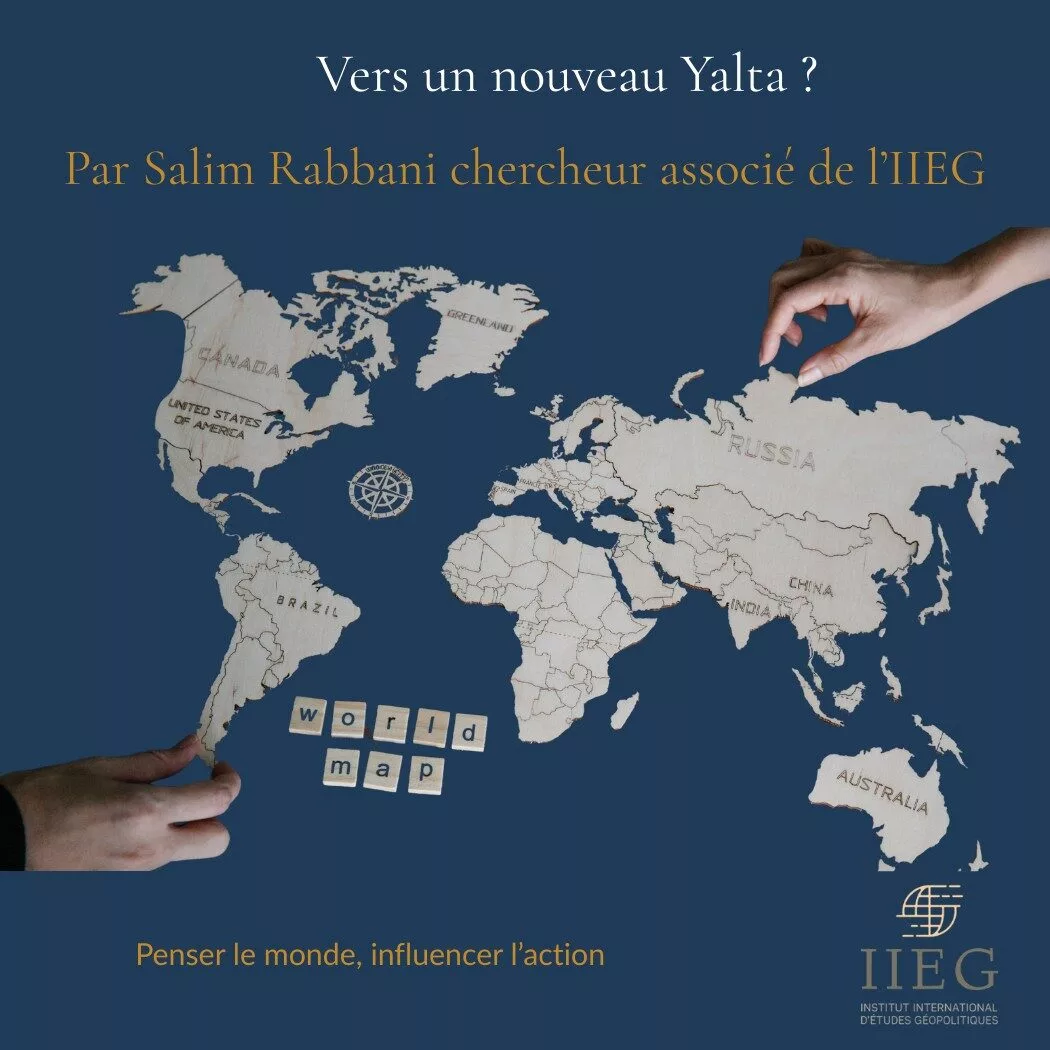
Towards a new Yalta process?
Salim Rabbani
IIEG Expert
In 1885 the Berlin Conference was held which decided the fate of Africa for the next sixty years. In 1943 the Anfa conference was held, in the famous Anfa district which overlooks the Atlantic and the White House of North Africa, Casablanca! In the famous Villa Dar es-Saada (House of Happiness), the leaders of the greatest world powers at war against the forces of the Germany – Japan – Italy Axis meet. MM Roosevelt for the USA, Churchill for the UK, and General De Gaulle for occupied France. They outline the contours of a future in the absence of Stalin who refused to go there. In Yalta in 1945, they met in the absence of France to finalize the design of the new bipolar world order, a transition to the immediate post-war period. Where are we today?
The first year of Donald Trump's mandate comes to an end and confirms the defensive refocusing of American geopolitics - in line with the Monroe Doctrine of 1823 amended by Theodore Roosevelt's corollary and what we can today call the second Trump corollary in reference to the final update of the national security strategy published by the White House on December 5, 2025[i] - for controlling energy and resources in its immediate vicinity. They practice aggressive "neo-containment", securing their backyard while fortifying their peripheral strongholds to face the Sino-Russian bloc as demonstrated in the following sequence. In Panama, faced with the obsolescence of infrastructure and the growing control of Chinese companies (CK Hutchison) over the terminal ports[ii], Washington imposed reinforced “security co-management”. Under the pretext of fighting drug trafficking and securing flows in the face of chronic drought, the United States reinvested the canal through bilateral defense agreements, de facto marking the end of the absolute neutrality of the passage in favor of an American technological protectorate. In Venezuela, the world's largest hydrocarbon reserve, the triggering of Operation Midnight Hammer[iii]” consisting of the surgical extraction of Nicolás Maduro by special forces and contractors was technically successful, unlike its political continuation, the outcome of which is not very clear. Nevertheless, the signal is interpreted as a warning shot to the international order and to China. In Cuba, the situation is at a crossroads. The final collapse of the electricity system and the end of Russian subsidies forced Havana into a wild economic opening. Washington uses migratory leverage and investments from the Florida diaspora to influence a market transition, while closely monitoring Chinese listening bases (Bejucal[iv]) which remain the last major point of friction. Interest in Greenland is not a simple real estate fad but a permanent Arctic necessity in American foreign policy. The base at Pituffik (formerly Thule) has been massively modernized. It is now the central node of the anti-missile shield and surveillance of submarine cables, confirming the 1867 doctrine[v]: the Arctic is the northern border of American internal security and is part of American vital space. In Iran, after the escalation of 2024-2025, the USA is practicing a strategy of “remote strikes” without engagement on the ground and is continuing its attempts to destabilize with Israel as proven by the latest internal upheavals[vi]. The pivot to Asia is the ultimate decoupling point. The activation of this sword of Damocles is on the agenda, its temporality will depend on the tactical evolution of the situation and Chinese reactions. Taiwan remains the epicenter of global tension. Washington has transformed the island into a technological and military “porcupine”. This “red rag” serves to test Beijing’s resilience and to justify massive rearmament in the Indo-Pacific. In 2026, the American strategy is clear: maintain increasingly muscular strategic ambiguity to prevent any forced unification which would signify the end of American naval hegemony. A return in time allows us to put the moment into perspective. The League of Nations (League of Nations), established in 1919 after World War I, aimed to ensure international cooperation and peace. However, it proved ineffective in the face of the expansionist ambitions of totalitarian regimes in the 1930s. The arrival of Adolf Hitler to power in Germany marked a turning point. Germany's withdrawal from the League of Nations in 1933 undermined the organization's authority. The widespread rearmament of Germany, in flagrant violation of the Treaty of Versailles, and the inability of the League to prevent it led to the outbreak of World War II in 1939. As early as 1942 (United Nations Declaration), the idea of a new organization emerged to succeed the League. The Allied conferences, notably that of Anfa and Yalta in February 1945, laid the foundations of the United Nations (UN), equipped with a Security Council where the main victorious powers (United States, USSR, United Kingdom, France, China) had a right of veto, thus guaranteeing their participation and, in theory, more decisive action. The immediate post-war period saw the emergence of a world divided into two ideological and military blocs dominated by the United States and the USSR. The UN has become the theater of indirect confrontation between the two superpowers. The veto power within the Security Council has often paralyzed the organization's action on major issues, however, thanks to the balance of terror, the UN has been able to serve as a vital diplomatic forum. The fall of the Berlin Wall in 1989 and the collapse of the USSR in 1991 brought an end to bipolarity. For a time, the Security Council, freed from the systematic Soviet veto, was able to act more effectively (first Gulf War, 1990-1991). The American political scientist Francis Fukuyama theorized this moment - the definitive triumph of liberal democracy and the market economy - as being the "end of history". In this vision, a unified world order seemed possible under the aegis of the West. However, this vision quickly faced new limits due to the growing unilateralism of the United States in the 2000s: difficulties in preventing and the resurgence of conflicts (Iraq War in 2003, without a clear mandate from the UN), increasing interference, retreat of international law in the face of the interests of the superpower and the new emerging powers, direct challenges to this order. The result was a fragility of the international order and an evolution towards a more fragmented and multipolar world. The divisions within the Security Council (Syria, Ukraine, Gaza) recall the paralysis which preceded the Second World War, and question the capacity of the big five to guarantee international peace and security. The short and medium-term outlook is affected. American strategy, as mentioned above, focuses on maintaining its hegemony, and strengthening the continental sphere of influence to guarantee the nexus via a stable, resource-rich rear base, as a prelude to potential global disruptions. The United States could propose arrangements to Moscow, to avoid a consolidated anti-American alliance. The pivot and use of tensions in the Middle East aims to disrupt Chinese energy supply routes and initiatives (such as the New Silk Roads[vii]), creating points of friction to divert attention and resources from Beijing. The ultimate goal could be to force a new world order where the United States and its Western allies clearly demarcate their spheres of influence, strategically isolating China and its partners. The sustainability of this policy is questioned in light of President Trump's age and the constitutional limits of his mandate. Rising figures like J.D. Vance are potential successors or architects of a post-Trump Republican foreign policy, potentially more coherent but just as isolationist or competition-oriented. These key elements will determine the future trajectory: control of energy flows remains central to economic and political power; the Middle East – a geopolitical powder keg – whose instability could either distract the attention of the great powers or serve as a lever of pressure; a possible Trump -Putin deal could reshape the balance of power in Eastern Europe and the Middle East; the global reserve currency status of the dollar is a major tool of influence for the United States, its challenge would be a major upheaval; Europe is no longer strategic and is relegated to second place in the great Sino-American rivalry; nuclear proliferation becomes the ultimate security guarantee for any state aspiring to protect its independence and sovereignty. Three main scenarios are emerging:- The path of reason (Competitive Coexistence): Great powers recognize the costs of direct confrontation and opt for intense economic and technological competition, but without major military conflict.
- The runaway and forced rebalancing (Major Conflict): an incident (in Taiwan, the China Sea, or the Middle East) degenerates into military conflict, leading to a brutally redesigned new world order.
- Chaos (Fragmentation): the international system fragments into rival blocs and multiple regional conflicts break out, without a power being able to impose its vision.