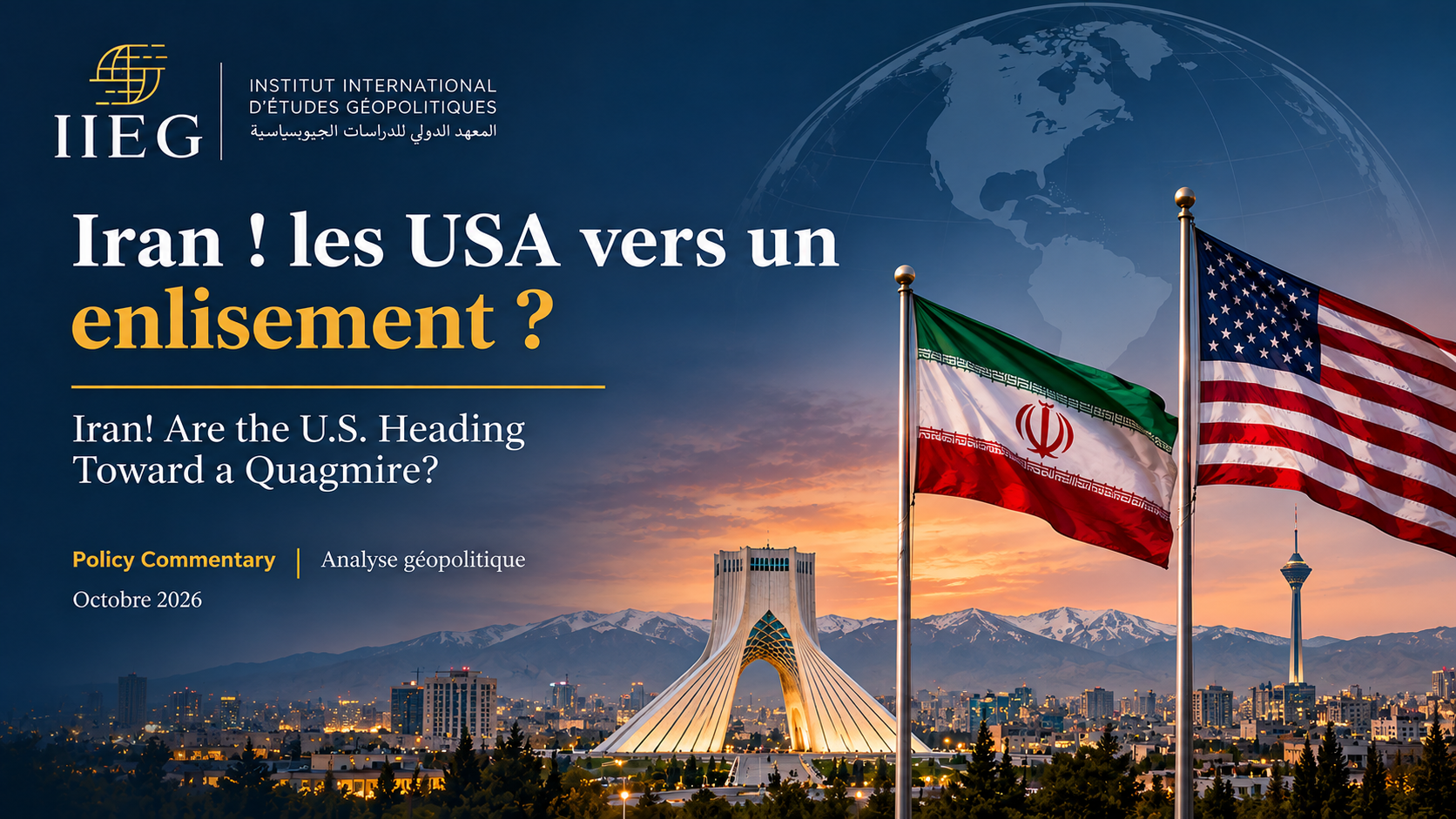
Iran! Are the United States Heading Towards a Quagmire?

Salim Rabbani
Directeur du pôle industrie néguentropique - Expert en stratégie, supply chain et management de la performance
Introduction
This new military chapter is part of a long history of struggles for control over Iran, the first country in the Middle East to experience a revolution and adopt a constitution in 1905.
From the beginning of the twentieth century, Iran attracted considerable attention from Russia and Britain, the latter controlling its oil from 1913 through the Anglo-Persian Oil Company (AIOC).
The abdication of Reza Shah in favor of his son, following the Anglo-Soviet invasion of 1941, brought Iran closer to Western powers. In 1945, the Iranian-Soviet crisis erupted following the USSR's attempt to establish pro-Soviet states in northern Iran.
In 1951, Prime Minister Mohammad Mossadegh nationalized the AIOC. The joint American-British Operation Ajax subsequently overthrew him, consolidating the autocratic regime of Mohammad Reza Pahlavi.
In 1979, the Islamic Revolution brought to power a theocratic system based on religious clerics, the mullahs, and the Islamic Revolutionary Guard Corps (IRGC), also known as the Pasdaran, effectively an army within the army, numbering approximately 200,000 personnel.
For 46 years, beginning on April 7, 1980, Iran has been subjected to American economic sanctions. On September 22 of the same year, Iraq, supported by the United States and its allies, invaded Iran. The war ended in 1990, according to the author's chronology, with more than one million deaths and a return to the 1975 Algiers Agreement.
American pressure did not diminish. Sanctions continued to intensify, while domestic protest movements persisted: the student demonstrations of 1999, the 2009 "Where Is My Vote?" movement, the 2017 uprising, and the 2022 "Woman, Life, Freedom" movement.
Following the Hamas attack on October 7, 2023, Israel significantly weakened the Iranian strategic network established by General Soleimani, comprising Hamas, Hezbollah, the Houthis in Yemen, and militias in Iraq and Syria.
The confrontation became increasingly direct, marked by continuous escalation: the clashes of April 2024 following Israel's bombing of the Iranian consulate in Damascus; Iranian missile launches between July and October 2024 following the assassinations of Hamas and Hezbollah leaders; the fall of the Assad regime in late 2024; and the Twelve-Day War of June 2025, involving direct American intervention through Operation Midnight Hammer.
Finally, in early 2026, an Iranian uprising originating in Tehran's Grand Bazaar, potentially involving external actors, failed to destabilize the regime.
Why this conflict?
According to the author's analysis, the underlying objectives are clear.
For Israel, the goal is to neutralize or eliminate a systemic regional rival possessing ballistic capabilities.
For the United States, the objective is to dismantle Iran's strategic position in order to weaken China by securing control over energy resources, while simultaneously containing Russia by blocking its southern flank.
As for the nuclear threat, the author considers it unsubstantiated, citing CIA assessments from 2024 and March 2025 indicating that Iran officially halted its nuclear weapons program in 2003.
The resignation of Joe Kent, Director of the National Counterterrorism Center, and the statements made on March 18, 2026, by U.S. Director of National Intelligence Tulsi Gabbard before a Senate committee are presented as supporting this interpretation.
The strategy initially adopted appears to have involved eliminating senior Iranian leaders during the early stages of the conflict, with the aim of triggering regime change or, at the very least, altering the behavior of the remaining leadership, as illustrated by the operation in Venezuela.
Underlying this approach, according to the author, is the persistent ambition to control energy reserves, thereby ensuring the viability of the petrodollar and maintaining American global leadership.
However, the elimination of Supreme Leader Ali Khamenei, approximately forty senior officials and high-ranking military officers, as well as interim successor Ali Larijani, has not produced the expected results.
Iran has established a decentralized system of governance and military command.
Like the mythical many-headed Hydra, the elimination of one leader immediately gives rise to another, without undermining Iran's ability to conduct asymmetric warfare, target forward American and Israeli military installations throughout the region, or exploit the strategic chokepoint of the Strait of Hormuz.
By selectively disrupting commercial shipping and energy transportation, Iran can exert pressure on the global economy and challenge the foundations of the seemingly all-powerful Pax Americana.
History as a mirror
The historical record of American military interventions suggests that a large-scale ground invasion and occupation of Iran is unlikely.
Instead, it points toward a prolonged conflict without a clear winner or loser in the short term, potentially followed by American disengagement over the medium term.
The Vietnam War, from 1955 to 1975, demonstrated that overwhelming military superiority does not necessarily guarantee strategic victory.
Despite the imbalance of forces, the United States ultimately withdrew, leaving approximately 58,000 American fatalities, more than one trillion dollars in expenditures, and one million Vietnamese deaths, according to the figures cited by the author.
The war in Afghanistan, from 2001 to 2021, cost more than $2.4 trillion, resulted in approximately 2,400 American deaths and 250,000 Afghan deaths, and ultimately ended with the Taliban's return to power.
The author describes the Taliban as having become a comparatively moderate political force within a local landscape also threatened by the more radical Islamic State–Khorasan Province (IS-K).
Iraq provides another illustrative example.
The 2003 invasion was justified by allegations concerning weapons of mass destruction. A military coalition was assembled, and the initial campaign was rapidly won.
The country's leadership was removed, including Saddam Hussein, and a new political system was established.
However, the situation deteriorated into armed political fragmentation, exacerbated by Sunni-Shia divisions and asymmetric warfare against occupying forces.
In 2011, after what the author estimates as one million Iraqi deaths and $3 trillion in expenditures, the United States withdrew.
This experience recalls a statement attributed to Henry Kissinger, according to which being an enemy of the United States may be dangerous, but being its friend can prove fatal.
The four clocks
Four interconnected strategic clocks determine the evolution of the situation.
The first clock: American domestic politics
Following the September 11, 2001 attacks and the extraordinary public reaction they generated, 87% of Americans supported military intervention in Afghanistan.
By contrast, according to the polling figures cited in the article, 59% of Americans disapprove of the attack against Iran in a CNN survey, while NBC reports 54% opposition.
One Republican in two reportedly favors ending the operation.
The November 2026 midterm elections are therefore a major consideration in American political calculations.
The second clock: The global economy
The disruption of the Strait of Hormuz, combined with threats to maritime navigation in the Gulf of Aden, has placed global shipping under considerable pressure.
International maritime traffic is being redirected around the Cape of Good Hope, adding approximately fifteen days to shipping routes.
Insurance premiums have reportedly increased tenfold.
The disruption affects approximately 20% of global oil and gas flows, equivalent to around 20 million barrels, primarily destined for Europe and Asia.
In response, the International Energy Agency has coordinated the release of approximately 400 million barrels from global strategic reserves, while the United States has announced the release of 172 million barrels from its own reserves.
These measures are intended to contain rising oil prices.
Nevertheless, inflationary pressures are intensifying, increasing the likelihood of higher interest rates and an economic recession.
The third clock: China
China, the world's second-largest oil consumer, uses approximately 16 million barrels per day.
According to the figures cited by the author, it imports 60% of its oil and 40% of its natural gas from the Middle East, with Iran accounting for approximately 13%.
China's export-driven economic model is suffering from these disruptions, while domestic consumption remains insufficient to compensate for the decline in external trade.
The redeployment of American military assets from South Korea to the Iranian front, under the doctrine of strategic flexibility governing United States Forces Korea (USFK), has additional geopolitical consequences.
These assets include THAAD missile defense systems, naval vessels, and ammunition.
Their transfer reduces American military pressure around China and weakens the security framework protecting regional allies, particularly Taiwan.
China is unlikely to confront the United States directly.
Instead, the author anticipates that Beijing will discreetly use its available instruments of influence to support Iran, protect its energy supplies, and preserve freedom of navigation.
Such a strategy could favor a prolonged conflict that serves Chinese interests by preventing Iran's strategic isolation.
The fourth clock: American strategic credibility
The fourth clock concerns the credibility of the United States as a security guarantor within the international security architecture, particularly in the Middle East, as well as Israel's security.
The Pax Americana is being challenged and, according to the author, is increasingly producing effects contrary to its intended purpose, becoming a catalyst for conflict.
Selective restrictions on maritime flows reveal the limitations of the current globalization model.
They accelerate the emergence of resilient and increasingly autonomous spheres of influence, structured around the water-energy-food-materials nexus.
This transformation reinforces strategic sovereignty, multipolar alliances, and vertical economic integration, challenging conventional theories of comparative advantage.
Multisourcing, friend-shoring, and inshoring are increasingly becoming structural elements of a new economic order shaped by geopolitical multipolarity.
Conclusion
Despite American military superiority, the influence of the military-industrial complex, and pressure from Israel and its lobbying networks, Iran's asymmetric response under the strengthened Revolutionary Guards, combined with the country's likely resilience, suggests a prolonged confrontation.
Over time, however, the combined effects of the four strategic clocks could gradually weaken the intensity of the conflict.
This scenario assumes that nuclear weapons will not be employed.
Nevertheless, it does not exclude the possibility of another front opening or the continuation of recurring confrontations with Iran over the medium term.
The central question remains unresolved: How can de-escalation be achieved without being perceived as a sign of weakness?
Update — October 10, 2026
Seven months later, the hypotheses concerning a prolonged conflict and the opening of another front have, unfortunately, been confirmed, according to the author's assessment.
Tensions remain extremely high in the Strait of Hormuz.
Meanwhile, the Bab el-Mandeb Strait has been under pressure from Yemen's Houthis since early September.
This development further strengthens Iran's strategic position while exposing the global economy to a dual shock.
Sources :
[1] « Quand la CIA complotait en Iran », Mark Gasiorowski, Le Monde diplomatique, Octobre 2000
[1] « Les Iraniennes allument un brasier social », Mitra Keyvan, Le Monde diplomatique, novembre 2022
[1] « Un défi à la nation Iranienne », Shervin Ahmadi et Marmar Kebir, Le Monde diplomatique, Juillet 2025
[1] “ Where is Iran’s national uprising headed ? ”, 14 janvier 2026, www.civilnet.am
[1] “Time to Get Tough” Donald J. Trump, Regnery Publishing, Washington DC, 2011, réédité en 2016 et 2024 sous le titre Making America Great Again
[1] https://www.lemonde.fr/idees/article/2026/03/17/la-lettre-de-demission-de-joe-kent-du-centre-national-americain-de-lutte-contre-le-terrorisme-l-iran-ne-representait-aucune-menace-imminente-pour-notre-nation_6671750_3232.html
[1] https://www.lemonde.fr/international/article/2026/03/18/guerre-en-iran-tulsi-gabbard-directrice-du-renseignement-national-contredit-donald-trump-et-affirme-que-teheran-n-avait-pas-relance-son-programme-nucleaire_6672134_3210.html
[1] Déclaration de M. James Michael Johnson, président Républicain de la chambre des représentants, le 3 Janvier 2026 en réponse à l’enlèvement de M. Nicolas Maduro « This is not a regime change but a change of behavior of a regime »
[1] « Donal Trump’s first Venezuela oil sale deal goes to megadonor’s company”, Financial Times, le 16 Janvier 2026
[1] https://www.connaissancedesenergies.org/afp/les-pays-de-laie-debloquent-massivement-leurs-reserves-strategiques-de-petrole-260311
[1] https://www.connaissancedesenergies.org/afp/petrole-les-etats-unis-vont-fournir-au-marche-172-millions-de-barils-de-ses-reserves-strategiques-260312
[1] https://www.lemonde.fr/international/article/2026/03/12/seoul-embarrasse-par-le-transfert-de-materiel-des-forces-americaines-de-coree-vers-le-moyen-orient_6670717_3210.html
[1] “ Annual report to Congress : Military and security developments involving the People’s Republic of China – 2025 “, https://media.defense.gov