The South Atlantic Corridor: Fertiliser, Grain and Capital

Hamza Belgourari
Vice-Président Brésil - Expert en diplomatie économique et entrepreneuriat stratégique
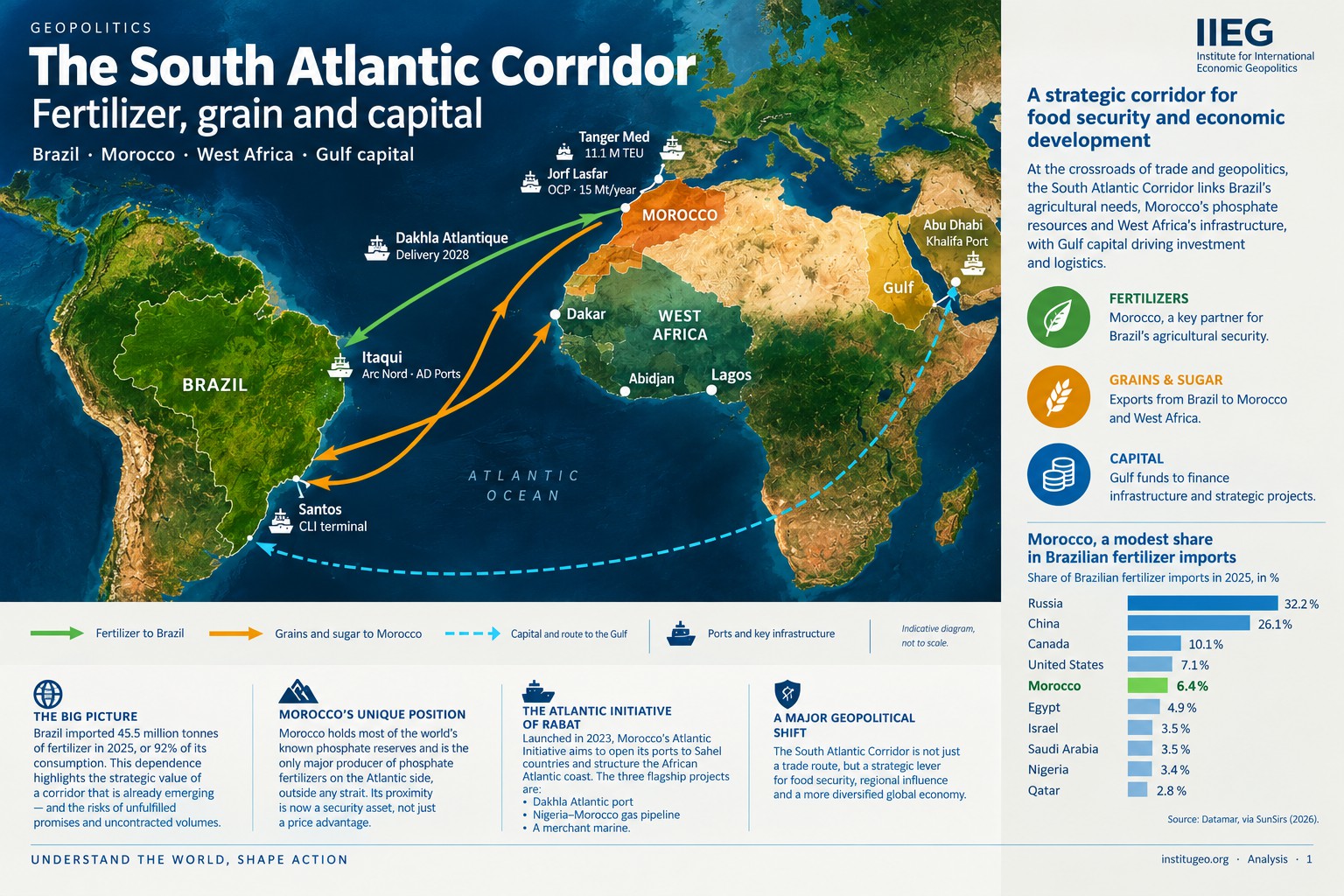
The partial closure of the Strait of Hormuz in 2026 confirmed what the war in Ukraine had already exposed: the leading agricultural power of the South Atlantic depends, to feed its soils, on routes it does not control. Brazil imported 45.5 million tonnes of fertiliser in 2025, roughly 92% of its consumption. In response to this vulnerability, an axis is taking shape between Brazil's Northern Arc, Morocco's Atlantic seaboard and West Africa, backed by Gulf capital. This South Atlantic corridor already exists along a single flow: Moroccan phosphates. Its strategic value lies in what remains to be built, and its weaknesses lie in the gap between announcements and the volumes actually contracted.
A realignment that shifts the centre of gravity to the Atlantic
The chokepoint shock: before the crisis, up to 30% of global fertiliser shipments passed through Hormuz. Iranian restrictions sent prices soaring at the very moment Brazilian farmers were buying inputs for the 2026/27 season. The geography of supply has become a factor of agricultural competitiveness.
Morocco's asymmetric advantage: Morocco holds most of the world's known phosphate reserves and is the only major producer of phosphate fertiliser located on the Atlantic side, clear of any chokepoint. Its geography is becoming an argument of security, not just of price.
Rabat's Atlantic doctrine: launched in 2023, the Atlantic Initiative aims to open Moroccan ports to the Sahel states and to structure Africa's Atlantic seaboard. Its three flagship projects are the Dakhla Atlantic port, the Nigeria-Morocco gas pipeline and the creation of a merchant fleet.
Fertiliser, the anchor flow of the corridor
Brazil imports 96% of its potash, 95% of its nitrogen and 72% of its phosphate. Morocco's position is real but still marginal: it accounts for only 6.4% of total imports, far behind Russia and China, while dominating the superphosphate segment. For OCP, the Brazilian market already represented 23% of global revenue in 2025, on a par with India.
The 18 September 2026 memorandum: OCP Nutricrops and Brazil's Ministry of Agriculture set a target volume of 3.8 million tonnes of phosphate fertiliser for 2026-2027, mainly TSP.
This is not a firm order: contracts must still be negotiated with each Brazilian distributor. It also opens an agronomic track, from soil mapping to bio-inputs. The limits of the lever: Morocco supplies neither potash nor nitrogen, which weigh most heavily in Brazil's dependence. The Emirati-Moroccan Dahamco green ammonia project in Dakhla, approved but not yet scheduled, could eventually open the nitrogen segment.
A trade loop that is already balanced
The corridor's least visible asset is the symmetry of trade. In 2025, Brazil exported USD 1.365 billion to Morocco, mostly sugar and maize, and imported USD 1.429 billion, 84.8% of it fertiliser. Morocco bought 1.81 million tonnes of Brazilian maize, 75% of it from Mato Grosso, the very region that consumes Moroccan phosphates.
The full-ship logic: balanced trade allows ships to sail loaded both ways, fertiliser outbound and grain on the return leg. This is the economic precondition for a regular shipping line, which does not yet exist.
African triangulation: Morocco is only the 44th destination for Brazilian exports. The corridor's value will therefore come not from bilateral trade but from projection into West Africa, where Brazilian exports reached a record USD 15.86 billion in 2024 and where Embrapa announced its return in 2025.
The port nodes: both ends are being built at the same time
Node | Role in the corridor | Status, October 2026 |
Tanger Med | Hub for Europe and the Mediterranean | 11.1 M TEU handled in 2025 (+8.4% |
Jorf Lasfar | OCP's export complex | 15 Mt/year fertiliser capacity |
Dakhla Atlantic | Gateway to West Africa and the Sahel | 74% complete, delivery end-2028 |
Itaqui | Grain outlet of the Northern Arc | CLI Norte terminal, controlled by AD Ports |
Santos | Brazil's leading agricultural port | CLI terminal, controlled by AD Ports |
Capacity ahead of demand: on opening, Dakhla will offer an expandable capacity of 35 million tonnes and an 18-metre draught, backed by a 1,650-hectare industrial zone.
Construction progress is not operation, however: the port's success will depend on sufficient industrial demand emerging. The Amazon link: on the Brazilian side, logistics hub projects along the Amazon river axis, such as Humaitá, can feed grain and inputs into the Northern Arc and strengthen the case for the port operators already present in Itaqui.
Gulf capital, the binding agent
A presence at both ends: in October 2026 AD Ports completed its USD 835 million acquisition of CLI, its largest ever, with the stated aim of linking Brazil directly to Khalifa Port and the Abu Dhabi Food Hub. In Morocco, Emirati commitments reportedly exceed USD 15 billion across water, energy, ports and hydrogen.
Competitor as much as partner: the Gulf is also a fertiliser supplier to Brazil: Saudi Arabia provided around 22% of the MAP Brazil imported in the first eight months of 2025. The Hormuz crisis gives these producers a reason to hedge their own risk on the Atlantic side.
The strategic case for sovereign funds: financing a fertiliser-grain route that avoids the chokepoints amounts to buying a hedge against Hormuz risk for their own food security.
Five weaknesses that will determine the corridor's credibility
The gap between announcement and contract: a memorandum is not a volume. Without purchase contracts signed with Brazilian distributors, the corridor will remain a diplomatic narrative.
The return of price competition: Russia and China together supply more than 58% of Brazil's fertiliser imports. Easing prices would reduce the appeal of diversification.
Political exposure: the break between Algeria and the UAE in September 2026, the disputed status of Sahara and the lack of a timetable for the Sahel states' access to the Atlantic weigh on the perception of European and multilateral lenders.
Concentration of funders: a corridor financed almost exclusively by the UAE would be tied to a single political alignment.
The data gap: no public study currently compares the logistics cost of a tonne of fertiliser between Jorf Lasfar and Itaqui with the Russian, Chinese or Gulf routes.
Recommendations
Priority | Action | Horizon |
1. Prove | Fertiliser-grain pilot Jorf Lasfar - Itaqui with OCP Brasil, AD Ports (CLI Norte) and Mato Grosso traders, without waiting for Dakhla | 2027 |
2. Measure | First comparative study of logistics costs and tariffs, published with a critical lens | Q1 2027 |
3. Diversify | Bring in Saudi Arabia, Qatar and Brazilian funds (PIF, SALIC, QIA, BNDES) | 2027 |
4. Project | "Cerrado model" agronomic pilot in Côte d'Ivoire or Senegal with Embrapa and OCP | 2028-2030 |
5. Verify | Without a signed contract by October 2027, refocus the initiative | Oct. 2027 |
Conclusion
The South Atlantic corridor is neither an abstraction nor yet a reality. It rests on a tangible flow, infrastructure under construction and capital already committed on both sides of the ocean. What it lacks is less financial than commercial: contracted volumes, a regular shipping line and public data able to convince beyond diplomatic circles. In a world where route security now outweighs cost optimisation, the South Atlantic offers Brazil, Morocco and the Gulf a rare convergence of interests. It still has to be measured in tonnes rather than in declarations.
References
• Colussi, J. and Langemeier, M. "Middle East Conflict Revives Concerns Over Fertilizer Dependence in the U.S. and Brazil", farmdoc daily, University of Illinois, April 2026.
• DatamarNews, "Brazil seeks emergency fertilizer supply from Russia, China and Morocco", 2026; Datamar via SunSirs, origins of Brazilian fertiliser imports, 2025.
• Argus Media, Brazilian SSP and MAP imports, January-August 2025.
• Brazilian Ministry of Agriculture (MAPA), agricultural attaché in Rabat: Brazil-Morocco trade 2025; MAPA - OCP Nutricrops memorandum, 18 September 2026 (NovaCana).
• CNN Brasil, Brazil-Morocco agricultural trade, June 2026; Government of Brazil, II Brazil-Africa Dialogue, May 2025.
• Tanger Med Port Authority, 2025 results; SGTM and Moroccan Ministry of Equipment, Dakhla Atlantic port progress, 2026.
• AD Ports Group, acquisition of Corredor Logística e Infraestrutura (CLI), June and October 2026.
• Médias24, Nigeria-Morocco gas pipeline, July 2026; MCG24 and Jeune Afrique, Morocco-UAE partnership, 2026.
• Analytical framework: energy-water-food nexus; friendshoring and regionalisation of value chains.