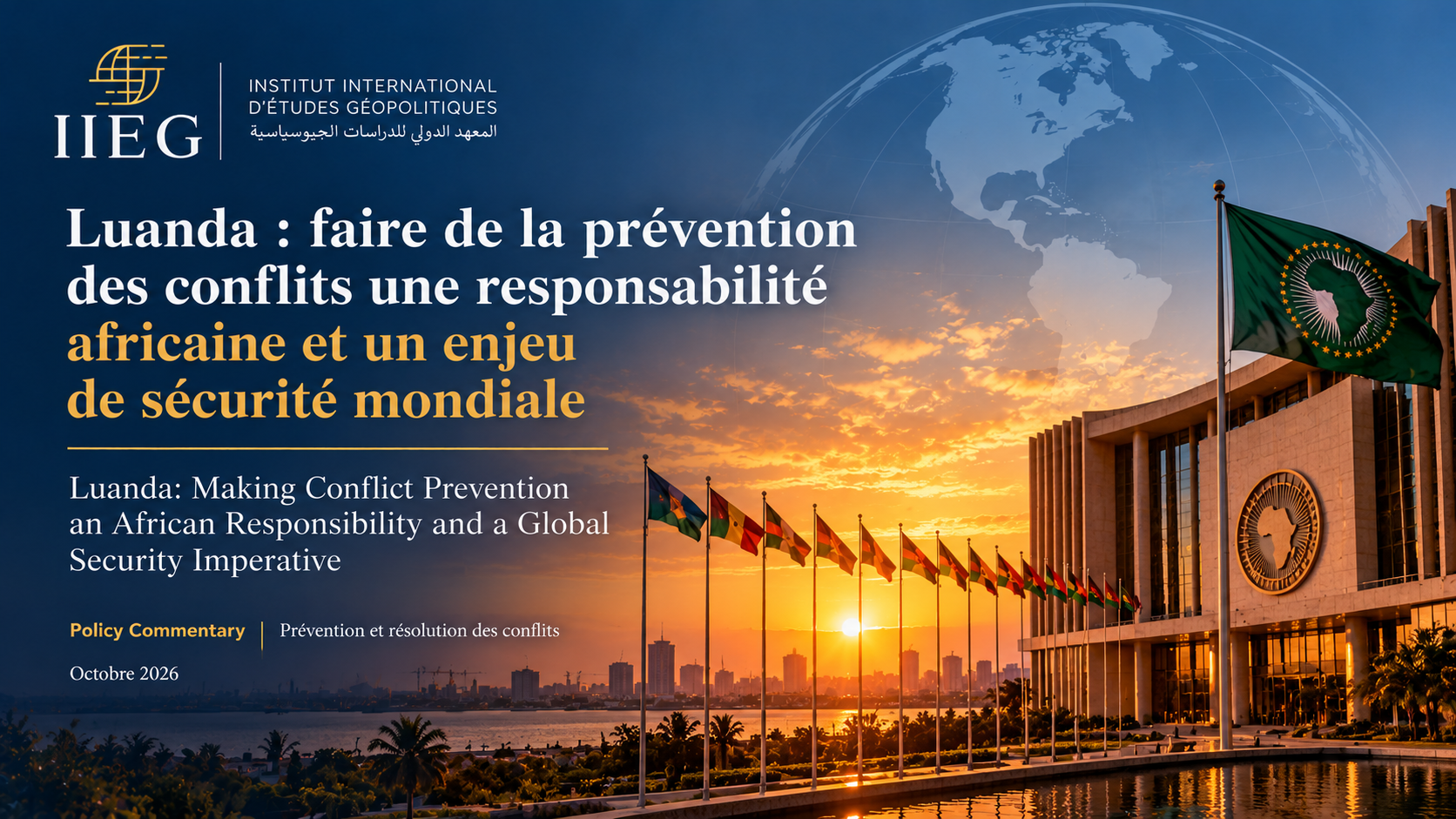
Luanda: Making Conflict Prevention an African Responsibility and a Global Security Imperative
Khaled Hamadé
IIEG Expert
A report prepared under the direction of the Conflict Prevention and Resolution Division
Contributors:
Khaled Hamadé, Abdoulaye Sène, Wafae Aziz, Karim Mourtada
A New Chapter for Peace and Security in Africa
The Conflict Prevention and Resolution Division of the International Institute for Geopolitical Studies (IIEG) has closely followed the discussions held in Luanda on strengthening African mechanisms for conflict prevention and resolution.
This extraordinary session of the African Union comes at a time when the African continent, like the international system as a whole, is facing a proliferation of crises, changing forms of conflict, and the weakening of certain traditional regulatory mechanisms.
In this context, the adoption of the Luanda Action Plan and its implementation matrix should not be regarded as yet another political declaration.
It reflects a deeper ambition: to gradually move from a culture of crisis response towards a genuine culture of prevention.
For the IIEG, this transformation is precisely where Luanda's strategic significance lies.
Africa's challenge is no longer simply to possess early-warning, mediation, and crisis-management mechanisms. It is now to ensure that strategic information is translated into political decisions early enough, and that those decisions are subsequently translated into action.
The African Paradox of Prevention
Africa is not starting from scratch.
Over recent decades, the continent has developed a substantial institutional architecture for peace and security: the African Union Peace and Security Council, early-warning mechanisms, the Panel of the Wise, mediation arrangements, regional economic communities, and peace-financing instruments.
The challenge is therefore not merely to create new instruments.
It also lies in ensuring that existing mechanisms operate in a coordinated, sufficiently rapid, and politically effective manner.
This is where what might be described as the African paradox of prevention emerges: warning signs of an impending crisis may be identified without the necessary diplomatic or political action always being initiated before the situation deteriorates.
Between identifying a risk and undertaking preventive intervention, a critical gap remains, shaped by state sovereignty, divergent interests, fragmented decision-making mechanisms, financial constraints, and, at times, insufficient political will.
Luanda must contribute precisely to narrowing this gap.
Africa Is No Longer a Peripheral Arena of Global Crises
African conflicts can no longer be analysed independently of transformations in the international system.
From the Sahel to the Horn of Africa, from the Great Lakes region to Sudan and Libya, crises are increasingly embedded in interconnected conflict dynamics involving domestic developments, regional rivalries, and international competition.
Energy, food and water security, migration, terrorism, transnational trafficking, climate change, emerging technologies, and competition over strategic resources can all act as factors of vulnerability, escalation, or internationalisation of crises.
At the same time, the consequences of African conflicts extend far beyond the borders of the states concerned and, frequently, beyond the continent itself.
The distinction between a national crisis, a regional crisis, and an international security issue is therefore becoming increasingly difficult to establish.
Africa's security is now an integral component of international security.
Africa must consequently be regarded not only as a region requiring preventive mechanisms, but also as a fully fledged actor in global stability.
This development requires strengthening African capacities for anticipation, mediation, and conflict resolution, while establishing more effective cooperation mechanisms between the African Union, regional organisations, the United Nations, and other international actors.
The Water–Climate–Security Nexus: A Central Dimension of Prevention
Conflict prevention must now fully incorporate hydro-diplomatic and environmental dimensions.
Water, climate, and security are no longer separate issues. They form an interconnected system of vulnerabilities, particularly evident in regions facing resource scarcity, land degradation, population displacement, and competition among agricultural, pastoral, urban, industrial, and energy uses.
The Water–Climate–Security Nexus provides a framework for understanding how environmental stress can amplify existing tensions, undermine social stability, and accelerate the regionalisation of crises.
Transboundary river basins, pastoral areas, lake regions, and territories experiencing significant demographic pressure should therefore be considered priority areas for preventive diplomacy.
Shared water management can become a driver of cooperation, provided it is supported by dialogue mechanisms, transparency, data sharing, and dispute-resolution procedures.
Conversely, the absence of coordination can transform local tensions into intercommunity crises and subsequently into disputes between states.
Anticipation must therefore combine climate, hydrological, agricultural, demographic, and security data to identify risks before they escalate into violence.
This approach also requires the participation of public authorities, regional organisations, local communities, farmers, pastoralists, water-sector stakeholders, and civil society organisations.
Water diplomacy should not be understood solely as negotiations between governments: it can also become a preventive instrument serving territories and populations.
From Early Warning to Action: The Real Challenge of Prevention
One of Luanda's principal lessons is the need to identify the drivers of crises before they develop into open conflict.
This approach directly reflects the vision promoted by the IIEG's Conflict Prevention and Resolution Division.
Preventing conflict does not simply mean preventing the outbreak of hostilities.
It also means:
- Identifying early warning signs;
- Understanding the underlying causes of tensions;
- Analysing political, economic, social, environmental, and territorial dynamics;
- Integrating interactions between water, climate, resources, and security;
- Mapping stakeholders and their interests;
- Identifying actors capable of facilitating mediation;
- Anticipating the regional and international repercussions of crises;
- Developing possible scenarios;
- Proposing, whenever feasible, options for prevention, mediation, and de-escalation.
Prevention must therefore become a permanent function of strategic analysis and decision-making support.
However, early warning is truly useful only when it leads to early action.
The challenge is consequently not merely to improve crisis detection, but to shorten the time between identifying a risk and taking a political decision.
Bottom-Up Prevention: Community and Local Mediation
Prevention cannot be effective if it remains exclusively institutional, diplomatic, or top-down.
Many crises originate in local tensions involving land disputes, access to water, transhumance, community rivalries, challenges to authority, economic marginalisation, or perceptions of injustice.
At this level, local actors often possess a detailed understanding of power relations, accumulated grievances, and opportunities for compromise.
Community and local mediation must therefore be recognised as an essential first level of prevention.
Traditional leaders, religious authorities, women's and youth associations, pastoral and agricultural organisations, locally elected representatives, community mediators, and civil society organisations can help defuse tensions before they become militarised or politically exploited.
Such bottom-up prevention requires strengthening local dialogue capacities, creating regular consultation forums, and ensuring the participation of directly affected groups, particularly women, young people, and displaced populations.
However, this approach should not be idealised.
Traditional mechanisms may themselves be contested, exclude certain population groups, or reproduce existing power imbalances.
They must therefore be connected to public institutions, regional mechanisms, and human rights protection standards.
Community → Local Authority → State → Regional Organisation → African Union → International Partners
The objective is to establish a multilevel prevention chain capable of identifying emerging tensions and rapidly mobilising the resources and mediators best suited to each situation.
National Sovereignty and African Responsibility
Any ambitious prevention policy nevertheless faces a structural difficulty.
Acting sufficiently early may sometimes require diplomatic engagement while a crisis still formally falls within a state's internal affairs.
Prevention therefore raises a fundamental political question:
How can respect for national sovereignty be reconciled with the need to act when an internal crisis threatens to become a source of regional destabilisation?
This question cannot be avoided.
Prevention can become a collective African responsibility only if states progressively recognise that anticipation, dialogue, and mediation do not necessarily undermine sovereignty.
On the contrary, they may help preserve sovereignty by preventing the deterioration of political and institutional mechanisms.
The credibility of Africa's peace and security architecture will therefore also depend on its capacity to build this trust.
Prevention Also Requires Financing
African strategic autonomy in conflict prevention cannot be separated from the question of financing.
There can be no genuine African ownership of prevention without the capacity to sustainably finance early-warning systems, mediation, preventive diplomacy, and peacebuilding mechanisms.
Excessive dependence on external financing can undermine the continuity of preventive mechanisms and limit the decision-making autonomy of African institutions.
Strengthening African capacities to finance peace must therefore be considered not merely a budgetary issue, but also a matter of strategic autonomy.
Africa's ability to prevent its own crises will also depend on its capacity to mobilise the resources necessary for action.
Clarifying Coordination Among Stakeholders
Prevention also requires more effective coordination between different levels of decision-making.
The African Union, the Peace and Security Council, member states, regional economic communities, the United Nations, and mediation actors may all become involved simultaneously in the same crisis.
This multiplicity is an asset when it enables complementary capacities to be mobilised.
It becomes a weakness when it produces diplomatic competition, duplicated initiatives, or diluted responsibilities.
An operational question must therefore remain central to the discussions initiated in Luanda:
Who detects? Who raises the alarm? Who decides? Who mediates? And within what timeframe?
An alert that circulates without triggering a decision does not, in itself, constitute a prevention policy.
Likewise, competing mediation initiatives may sometimes reduce the effectiveness of diplomatic action that requires unity, coherence, and speed.
Strengthening coordination between continental institutions, states, regional organisations, and local actors is therefore one of the major challenges facing any African prevention architecture.
From Prevention to Peacebuilding
Conflict prevention must not be regarded as an isolated activity.
It forms part of a continuum:
Anticipation → Prevention → Mediation → De-escalation → Resolution → Peacebuilding
When a conflict cannot be prevented, the objective becomes to prevent its expansion, regionalisation, or escalation.
Once an agreement is reached, the challenge shifts to preventing the re-emergence of the factors that caused the crisis.
A genuine prevention policy must therefore be conceived before, during, and after conflicts.
The IIEG: Analyse, Anticipate, and Propose
Within this dynamic, the International Institute for Geopolitical Studies intends to contribute to the discussions initiated in Luanda in accordance with its own mission: producing analysis, shedding light on conflict dynamics, and formulating proposals capable of enriching reflection on conflict prevention and resolution.
The IIEG does not seek to replace states, the African Union, regional organisations, or international institutions responsible for implementing peace and security policies.
Its role is that of an independent research and analysis institute.
Through its Conflict Prevention and Resolution Division, it can nevertheless contribute to examining the strategic questions raised in Luanda by mobilising a geopolitical, forward-looking, and multidisciplinary approach.
The Division's work may focus in particular on structural drivers of conflict, early warning signs of emerging crises, interactions between national, regional, and international dynamics, and the conditions required to strengthen prevention, mediation, and de-escalation mechanisms.
Particular attention may also be given to coordination among stakeholders, the political and economic conditions of prevention, the consequences of international geopolitical realignments for African crises, and emerging vulnerabilities that could affect continental stability.
Specific consideration may be devoted to the Water–Climate–Security Nexus and local prevention mechanisms.
Based on its analyses and studies, the IIEG may formulate proposals, identify avenues for further reflection, and develop scenarios that contribute to the strategic debate on the evolution of African conflict prevention and resolution mechanisms.
Two Foresight Instruments to Support Strategic Reflection
To translate this analytical and advisory capacity into concrete initiatives, the IIEG could develop two complementary instruments, conceived as tools for research, foresight, and dialogue rather than institutional monitoring or intervention mechanisms.
A Foresight Barometer of Early Warning Signals
The Conflict Prevention and Resolution Division could develop a Foresight Barometer of Early Warning Signals to structure the monitoring of factors likely to foreshadow a crisis or accelerate its deterioration.
This barometer would combine political, social, economic, environmental, climate, hydrological, and security indicators, including community tensions, population displacement, land and water disputes, breakdowns in dialogue, pressure on essential resources, disinformation, local or cross-border violence, and signs of militarisation or internationalisation.
Its purpose would not be to mechanically predict conflicts or evaluate the performance of competent institutions.
Rather, it would provide forward-looking assessments of vulnerabilities, trends, and potential tipping points.
It could result in periodic analytical briefs, risk maps, territorial profiles, and thematic studies.
Preventive Diplomacy Roundtables
In parallel, the IIEG could organise Preventive Diplomacy Roundtables bringing together, depending on the subject, researchers, diplomats, experts, institutional representatives, local actors, community mediators, and civil society organisations.
These forums would aim to compare analyses, identify differences in interpretation, explore de-escalation scenarios, and generate proposals.
Particular attention could be given to emerging crises, transboundary water basins, pastoral areas, and territories highly exposed to the effects of climate change.
The IIEG would thus position itself as an independent platform for reflection and dialogue, without replacing official mediators or competent institutions.
These two instruments would create closer links between foresight analysis, early warning signals, multidisciplinary expertise, and the formulation of proposals.
This contribution fully reflects the mission of a geopolitical research institute: not to make decisions in place of competent institutions or oversee their actions, but to understand ongoing transformations, anticipate risks, and place expertise at the service of informed proposals.
From Analysis to Proposals
Conflict prevention requires a permanent capacity to think ahead of crises.
Geopolitical analysis can help identify vulnerabilities, connect phenomena that are often studied separately, and explore alternative scenarios.
It is within this space that the IIEG's Conflict Prevention and Resolution Division intends to position its contribution.
Depending on the subjects and situations examined, its work may produce analyses, foresight studies, strategic briefs, and proposals intended to inform reflection on ways to prevent the emergence, escalation, or regionalisation of crises.
This approach rests on a fundamental conviction:
Research and analysis do not replace political and diplomatic action, but they can help guide it more effectively.
From Luanda to the World: Rethinking Peace
The true significance of Luanda extends beyond Africa alone.
In a world characterised by geopolitical fragmentation, multiplying crises, competition among major powers, and challenges to traditional mechanisms of international regulation, conflict prevention is becoming a collective responsibility.
Africa can and must play its full part.
However, Luanda's impact should not be assessed solely on the quality of the commitments adopted.
It should primarily be measured by the ability of those commitments to encourage earlier action, improve coordination among stakeholders, and enable political and diplomatic responses before the human, economic, and strategic costs of a crisis become considerably more difficult to manage.
This prevention must be both institutional and territorial, diplomatic and community-based, political and environmental.
It must integrate tensions related to water, climate, and resources, while giving local actors a meaningful role in developing de-escalation solutions.
The transition from a culture of reaction to a culture of prevention will therefore depend not only on the institutions established or the texts adopted.
It will depend on the collective ability to transform anticipation into decisions, decisions into action, and action into results.
This is the reflection to which the IIEG intends to contribute through its Conflict Prevention and Resolution Division, by means of analysis, anticipation, the study of early warning signals, dialogue between areas of expertise, and the formulation of proposals.
Prevent rather than endure.
Understand before acting.
Analyse to contribute to peace.